Ocean Life Records Screensaver
The Ocean Life Records screensaver shows recent marine species observations from OBIS, the Ocean Biodiversity Information System, key-less. It's free, runs in your browser, and ESC exits.
Live preview
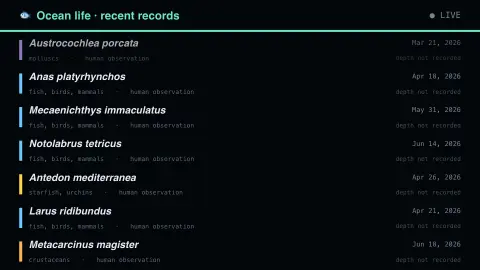
Press ESC to leave fullscreen. Settings are saved in your browser only.
How the Ocean Life Records screensaver works
The saver reads the source described above and draws it on a canvas — no account, no tracking.
Recent marine species observations from OBIS, the Ocean Biodiversity Information System, key-less. The marine counterpart to the site's GBIF saver, and the only one of the two that routinely carries the depth an animal was recorded at.
It refreshes on a schedule, so what you see stays current.
Colours and any options can be changed in settings; nothing is stored beyond your own browser.
About the Ocean Biodiversity Information System
OBIS is a global open-access database of marine species occurrence records. It operates under the Intergovernmental Oceanographic Commission of UNESCO, which adopted it in 2009 as part of its International Oceanographic Data and Information Exchange programme, and the Flanders Marine Institute (VLIZ) in Belgium has been its long-term host since 2011. It does not collect specimens itself: it is a network of regional and thematic nodes that publish datasets from many contributors into one searchable database.
Datasets are published using community standards such as Darwin Core and Ecological Metadata Language, so each record has a scientific name, a location and a date. Records can be searched by species name, taxonomic level, area, time and depth. Taxonomic decisions draw on the World Register of Marine Species, also maintained by VLIZ, which supplies the hierarchy used to navigate OBIS content.
The coverage is uneven. Some regions are far better sampled than others, so a map of observations partly shows where researchers have looked. A recent record may also be an older survey that was only recently published, and a species appearing somewhere is evidence it was recorded there, not a population count.
A worked example
Recent marine species observations from OBIS, the Ocean Biodiversity Information System, key-less. The marine counterpart to the site's GBIF saver, and the only one of the two that routinely carries the depth an animal was recorded at.
Settings & tips
- Accent and Background recolour the display.
- Every number on screen comes from the live source — nothing is simulated.
- Press ESC to leave fullscreen.
Frequently asked questions
- Is this real data?
- Yes — it comes from the source named on this page and is refreshed on a schedule.
- Is a key needed?
- No. This source is fully key-less.
- Is it free?
- Yes — free, no download, in your browser.
- Who runs OBIS?
- It runs under the Intergovernmental Oceanographic Commission of UNESCO as part of its IODE programme, and the Flanders Marine Institute (VLIZ) in Belgium is its long-term host.
- Are these all live sightings?
- No. Records include historical surveys and datasets published later, so a new entry in the database can describe something observed long ago.
- Does a gap on the map mean no life there?
- No. It usually means little or no data has been recorded or submitted for that region, because sampling effort varies widely.