Norwegian Krone Screensaver
The Norwegian Krone screensaver shows what one krone buys, from Norges Bank's key-less data API. It's free, runs in your browser, and ESC exits.
Live preview
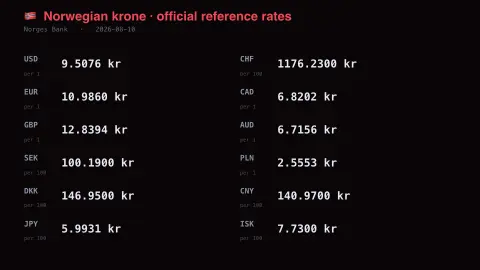
Press ESC to leave fullscreen. Settings are saved in your browser only.
How the Norwegian Krone screensaver works
The saver reads the source described above and draws it on a canvas — no account, no tracking.
What one krone buys, from Norges Bank's key-less data API. The answer arrives as SDMX-JSON, where observations are keyed by position into separate dimension lists rather than named, and some currencies are quoted per hundred units rather than per one.
It refreshes on a schedule, so what you see stays current.
Colours and any options can be changed in settings; nothing is stored beyond your own browser.
Why some currencies are quoted per hundred
Norges Bank is the central bank of Norway, and it publishes daily exchange rates for the Norwegian krone against many currencies through an open data API. They are middle rates, the midpoint between buying and selling rates in the interbank market, published at about 16:00 CET and described as indicative only, so they do not move through the day the way a market screen does.
A quirk of the convention is the quoting unit. Some currencies, such as the Swedish krona and the Japanese yen, are quoted as how many kroner buy 100 units rather than one, which the API flags with a unit multiplier of 2, while the euro is quoted per one. Read the unit label before comparing two figures, since a number per 100 is not directly comparable to one per 1.
The data format is SDMX-JSON, a statistical standard in which each observation is addressed by its position in separate lists of dimensions such as currency and date, so the saver has to join those lists back together before it can draw anything. The daily series is for business days, so the display uses the latest available value. It describes rates and is not a trading or advisory tool.
A worked example
What one krone buys, from Norges Bank's key-less data API. The answer arrives as SDMX-JSON, where observations are keyed by position into separate dimension lists rather than named, and some currencies are quoted per hundred units rather than per one.
Settings & tips
- Accent and Background recolour the display.
- Every value on screen comes from the live source — nothing is simulated.
- Press ESC to leave fullscreen.
Frequently asked questions
- Is this real data?
- Yes — it comes from the source named on this page and is refreshed on a schedule.
- Is a key needed?
- No. This source is fully key-less.
- Is it free?
- Yes — free, no download, in your browser.
- Why does the yen figure look so different from the euro figure?
- The yen is quoted per 100 units while the euro is quoted per one, so the numbers sit on different scales.
- Why is there no new rate on weekends?
- Norges Bank publishes daily rates for business days, so the most recent published value is shown until the next one.