Newest Vulnerabilities Screensaver
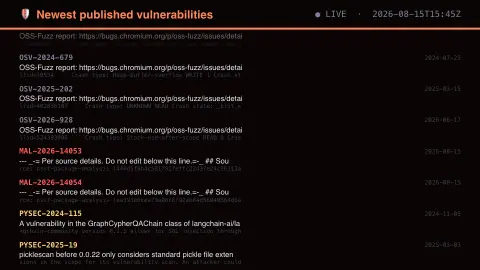
The Newest Vulnerabilities screensaver lists the most recently published security advisories from CIRCL's aggregator, which indexes more than the CVE list alone. Three identifier families appear: CVE, PYSEC from the Python advisory database, and MAL — which marks a package that is itself malicious rather than merely flawed. It runs in the browser with nothing to install; press ESC to exit.
Live preview
Press ESC to leave fullscreen. Settings are saved in your browser only.
How the Newest Vulnerabilities screensaver works
The saver reads CIRCL's vulnerability aggregator, refreshed through this site's pipeline.
No account and no key: the request goes straight from your browser, or from this site's own refreshed copy of the feed where the source does not allow browser access.
Values are drawn on a canvas that resizes with the window, so it works on a laptop or a wall display.
If the source is unreachable the saver says so on screen rather than showing stale numbers as though they were current.
CIRCL and the vulnerability aggregation problem
CIRCL, the Computer Incident Response Center Luxembourg, is the CERT for the private sector, communes and non-governmental entities in Luxembourg, and is part of the Luxembourg House of Cybersecurity. One of its services is Vulnerability-Lookup, an open tool to search, correlate and browse vulnerability information. It draws on many sources at once, including the CVE Program, the NVD, GitHub, PySec, OpenSSF Malicious Packages and CSAF feeds from vendors and CERTs.
Vulnerability-Lookup describes itself as identifier-agnostic: it links related vulnerabilities together regardless of the identifier format. The CVE Program supplies the familiar CVE numbers, but other ecosystems publish their own advisories under their own identifiers.
Where a severity score is shown, it commonly comes from CVSS, the Common Vulnerability Scoring System, which rates a flaw from 0.0 to 10.0. The Base score covers intrinsic characteristics that stay constant; Temporal metrics adjust for things that change, such as exploit availability and patch status; Environmental metrics adjust for a particular organisation. A Base score is a measure of severity, not of risk to your own systems, so treat this as an awareness display and not as patching guidance.
A worked example
Each entry leads with its identifier in colour — orange for CVE, amber for PYSEC, red for MAL — followed by the advisory text and the publication date. A MAL row is the one to notice: it means somebody uploaded hostile code to a package registry and it was caught, which is a different category of problem from a bug in honest software.
Settings & tips
- Accent and Background recolour the display without changing the data.
- Add it to a Multi-view grid to watch it alongside other live savers.
- Press ESC at any time to leave fullscreen.
Frequently asked questions
- What is the difference between CVE, PYSEC and MAL?
- CVE is the general catalogue of software vulnerabilities. PYSEC comes from the Python ecosystem's own advisory database. MAL marks a deliberately malicious package rather than a flawed one — supply-chain attack rather than programming error.
- Is this every new vulnerability?
- No. It is the most recent entries CIRCL has indexed, which is broad but not exhaustive, and there is always a lag between disclosure and publication.
- Is this real data?
- Yes. It comes from CIRCL's vulnerability aggregator, refreshed through this site's pipeline. Nothing is invented or simulated, and if the source cannot be reached the saver reports that instead of drawing something plausible.
- Does it cost anything or need an account?
- No. Every screensaver here is free, runs in the browser and needs no sign-up. This one uses a public API that requires no key.
- What does CVSS actually score?
- It rates the technical severity of a vulnerability on a scale of 0.0 to 10.0. The Base score reflects intrinsic characteristics, and it does not account for how an individual organisation is exposed.
- Why can a score change after publication?
- CVSS includes Temporal metrics, such as whether exploit code exists or a patch is available, which change over time. Records can also be revised as more is learned.