Cyber Threat Map Screensaver
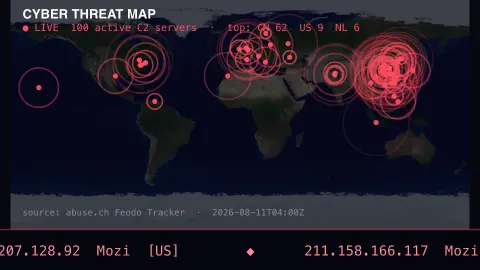
The Cyber Threat Map screensaver is a security-operations view of active botnet command-and-control servers, pulled live from the abuse.ch Feodo Tracker and plotted on a world map by country, with a scrolling feed of each server's IP, malware family and network. It only displays public threat intel — nothing is attacked — and it's free, runs in your browser, and ESC exits.
Live preview
Press ESC to leave fullscreen. Settings are saved in your browser only.
How the Cyber Threat Map screensaver works
A background job downloads abuse.ch's Feodo Tracker — a free public feed of IP addresses currently acting as command-and-control (C2) servers for banking-trojan botnets like Emotet, Dridex and QakBot — and saves it to a data file. (The feed isn't readable from a browser, so it's fetched server-side.)
Each C2 server carries a country code. The saver looks that up in a built-in table of country centroids and drops a marker there — nudged slightly so several servers in one country don't overlap — pulsing like a radar ping.
Underneath, a ticker scrolls the live indicators (IP address, malware family, country and hosting network) the way a security operations centre dashboard would, while a header tallies the total active servers and the top countries.
It is purely a visualisation of public threat intelligence: it reads a list and draws it. Nothing is scanned, contacted or attacked.
Botnets, command servers and abuse.ch
A botnet is a collection of infected computers controlled remotely by criminals, often used to steal credentials, deliver further malware or launch attacks. The infected machines need instructions, and these come from command-and-control servers, abbreviated C2. If defenders can identify those servers and block traffic to them, an infection loses much of its power, which is why lists of them are valuable.
abuse.ch is an independent, community-driven project that shares malware and botnet data with security researchers, network operators and law enforcement. It runs several platforms, including MalwareBazaar, URLhaus and ThreatFox. Feodo Tracker, which is operated by abuse.ch, shares botnet command-and-control servers and offers blocklists to help network owners protect users, covering families such as Dridex, TrickBot, Emotet, QakBot and BazarLoader.
The map shows where an address is located according to geolocation data, which places a server in a country but says little about who runs it. Criminals can rent servers in many countries, and addresses are moved or taken offline, so any list of them turns over. The country is therefore a property of the hosting, not of the attacker, and counts tell you about infrastructure, not the number of victims.
A worked example
On a typical day the map shows a scatter of pulsing markers — often concentrated in the United States and Europe where much cloud hosting lives — while the feed scrolls entries like 185.x.x.x · Emotet · DE · HETZNER. The active-C2 count rises and falls as abuse.ch confirms new servers and retires dead ones, so the picture genuinely changes through the day.
Settings & tips
- Threat color sets the marker and feed colour — classic red, or your own.
- Turn the feed ticker off for a pure map, or speed it up with feed speed.
- Pulse speed controls how fast the radar-style markers ping.
Frequently asked questions
- Is this real threat data?
- Yes. It comes from abuse.ch's Feodo Tracker, a respected public feed of active botnet command-and-control servers, refreshed on a schedule.
- Does this screensaver attack anything or get me hacked?
- No. It only reads and displays a public list of known-bad servers. It never scans, contacts or attacks anything — it is a visualisation, like a dashboard.
- What are botnet C2 servers?
- Command-and-control servers are the machines criminals use to control malware-infected computers. Tracking and blocking them is a normal part of cyber defence.
- Why does the number of threats change?
- The feed lists servers that are currently active. As abuse.ch confirms new ones and retires inactive ones, the count and the map update accordingly.
- Is the cyber threat map screensaver free?
- Yes, free and browser-based with no key or download. Run it fullscreen and press ESC to exit.
- Does a server being in a country mean criminals are from there?
- No. Attackers can rent or compromise servers anywhere, so location reflects where the machine sits and says little about who controls it.
- What is a command-and-control server?
- It is a server that infected machines contact to receive instructions. Blocking traffic to known C2 servers can cut an infection off from its operators.
- How do defenders use lists like this?
- Feodo Tracker offers blocklists that network owners can use to block or flag connections to known botnet command servers.