Moon Phase Screensaver
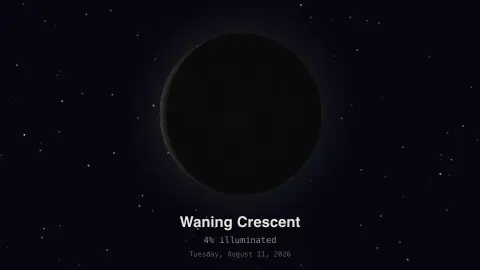
The Moon Phase screensaver shows tonight's real lunar phase, calculated from the current date and shaded in 3D against a field of twinkling stars. It computes how far the Moon is through its 29.53-day cycle right now, so the slice of light you see matches the actual sky, and it labels the phase name and percent illuminated. It is free, runs in your browser with no download, and you press ESC to exit.
Live preview
Press ESC to leave fullscreen. Settings are saved in your browser only.
How the Phase of the Moon screensaver works
The screensaver converts the current time to a Julian date, then measures the Moon's age against a known new moon and the synodic month of 29.53058867 days. Dividing the age by that period gives a phase fraction from 0 (new) through 0.5 (full) back to 1 (new).
That fraction drives the lighting direction. A light vector is derived from the phase angle and used to shade a sphere pixel by pixel: each point's illumination is the dot product of its surface normal with the light, so the lit crescent or gibbous matches the real phase. Because the date is read locally, no internet connection is needed.
Surface detail is faked tastefully — a handful of craters darken small regions and limb darkening dims the edges of the disc for a rounded, three-dimensional look. The lit areas are tinted with the Moon color you choose.
When the label is enabled, it derives a phase name (New, Waxing Crescent, First Quarter, and so on) from the same fraction, computes the illuminated percentage, and prints today's full date underneath.
Reading the Moon’s calendar
The Moon’s phases are the changing view, from Earth, of the half of the Moon that is lit by the Sun. They repeat in the synodic month of about 29.5 days, the time from one new moon to the next. That differs from the sidereal month of about 27.3 days, the time the Moon takes to orbit Earth once, because Earth is moving around the Sun meanwhile and the Moon must travel a bit further to catch up to the same alignment.
A calculation based on an average month is close but not exact. The Moon’s orbit is elliptical and its speed varies, so the real moment of new or full moon can differ from the average prediction by hours. Almanacs use more elaborate formulas for that reason, so a simple calculation is good for a pretty picture and not for timing an eclipse.
Where you live changes what you see. From the northern hemisphere a waxing moon is lit on its right side, and from the southern hemisphere the same phase appears lit on the left, because the two observers see the Moon from opposite orientations. The illuminated fraction also does not change in a straight line, since it depends on the cosine of the phase angle.
A worked example
With the defaults — Moon color #e8e6d8, Show phase name on, Glow on, and a Sky color of #05060f — the Moon hangs slightly above center, drifting gently, with its current phase name and a line like "78% illuminated" plus today's date beneath it. The warm off-white disc sits inside a soft halo against the deep-blue night sky. Turn Show phase name off for a clean, label-free Moon, or change the Sky color to recolor the night.
Settings & tips
- Leave Show phase name on to display the phase label, percent illuminated and today's date; turn it off for just the Moon.
- Pick a warmer or cooler Moon color to tint the lit surface to your taste.
- Adjust the Sky color and toggle Glow to set how much the Moon stands out from the night.
Frequently asked questions
- Does the moon phase screensaver show tonight's real moon?
- Yes. It computes the Moon's current age from today's date and the 29.53-day lunar cycle, so the phase shown matches the real Moon in the sky.
- Does the moon phase screensaver need the internet?
- No. The phase is calculated locally from your device's date and clock, so it works fully offline with no connection required.
- Does it show the percent of the moon that is illuminated?
- Yes. When the label is on, it prints the phase name, the percent illuminated, and today's full date beneath the Moon.
- Is the moon phase screensaver free?
- Yes. It is completely free with no download or sign-up. It runs in your browser and you press ESC to exit.
- Can I hide the phase name and percentage?
- Yes. Turn off the Show phase name toggle to display just the shaded Moon with no text labels.
- Why does the Moon look flipped in the southern hemisphere?
- Observers in the south view the sky from the opposite orientation, so the same lit side appears on the opposite side of the disc.
- Why is the cycle 29.5 days if the Moon orbits in 27.3?
- Earth moves along its orbit around the Sun while the Moon circles us, so the Moon needs about two more days to return to the same position relative to the Sun.
- Is this precise enough to plan an observation?
- It is accurate enough for the general phase, but an average-month calculation can be off by hours. Use an astronomical almanac for exact times.