One Disease, Many Names Screensaver
The One Disease, Many Names screensaver shows the Monarch Initiative's cross-species view of human disease, key-less. A search returns the same condition several times under different identifiers — MONDO for the disease concept, HP for the human phenotype, MP for the mouse one — and that repetition is not noise: it is the mapping that lets a mouse model say anything about a person. It's free, runs in your browser, and ESC exits.
Live preview
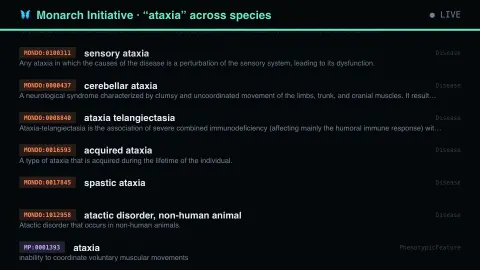
Press ESC to leave fullscreen. Settings are saved in your browser only.
How the One Disease, Many Names screensaver works
The saver reads the source described above and draws it on a canvas — no account, no tracking.
The Monarch Initiative's cross-species view of human disease, key-less. A search returns the same condition several times under different identifiers — MONDO for the disease concept, HP for the human phenotype, MP for the mouse one — and that repetition is not noise: it is the mapping that lets a mouse model say anything about a person.
It refreshes on a schedule, so what you see stays current.
Colours can be changed in settings; nothing is stored beyond your own browser.
How a mouse model says anything about a person
The Monarch Initiative is an open research project that integrates phenotype and genotype data from many species so that findings in one organism can be compared with another. It describes phenotypes with ontologies, controlled vocabularies with stable identifiers: Mondo for diseases, the Human Phenotype Ontology (HP) for human abnormalities and the Mammalian Phenotype Ontology (MP), which the Mouse Genome Informatics resource uses to annotate mouse phenotypes.
Mondo is a unified disease ontology that merges sources such as OMIM, Orphanet and NCIt and resolves conflicts between their classifications. The Unified Phenotype Ontology, uPheno, integrates organism-specific phenotype ontologies, including HP and MP, using bridging axioms, which allows queries that span species. Monarch uses such matching to find candidate genes and animal models for human diseases.
The identifiers are a means to an end. The same condition can turn up several times in a search because each ontology has its own entry for it, and a match in the graph is a hint, not proof of a causal link. Biology differs between mice and people, so such mappings help generate hypotheses that still need testing in experiments.
A worked example
The Monarch Initiative's cross-species view of human disease, key-less. A search returns the same condition several times under different identifiers — MONDO for the disease concept, HP for the human phenotype, MP for the mouse one — and that repetition is not noise: it is the mapping that lets a mouse model say anything about a person.
Settings & tips
- Accent and Background recolour the display.
- Every value on screen comes from the live source — nothing is simulated.
- Press ESC to leave fullscreen.
Frequently asked questions
- Is this real data?
- Yes — it comes from the source named on this page and is refreshed on a schedule.
- Is a key needed?
- No. This source is fully key-less.
- Is it free?
- Yes, and it runs entirely in your browser.
- What is an ontology in this context?
- It is a structured vocabulary in which each term has a unique identifier and defined relationships to other terms. This lets computers compare descriptions that use different words.
- Why use mice to study human disease?
- Researchers can alter a gene in a mouse and observe the resulting phenotype, and Monarch links mouse phenotype annotations to human ones. The animals are only a model, so results may not transfer directly.
- Does a match mean the mouse model replicates the human disease?
- No. A match means there is a similarity in phenotype or gene that is worth investigating, but it does not prove the same mechanism operates in humans.