Six Thousand Ways To Be Rare Screensaver
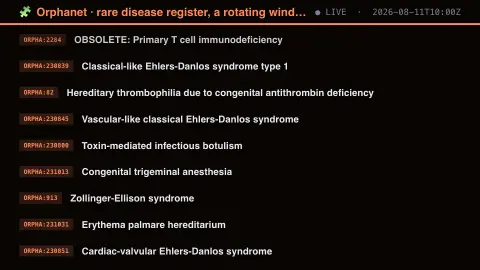
The Six Thousand Ways To Be Rare screensaver shows rare disorders from Orphanet, key-less. Every entry carries an ORPHA code, which exists because most of these diseases have no code of their own and are otherwise invisible to health systems that count by code. There is no date and no ranking in the dataset, so rather than imply a recency it does not have, the window rotates with the day. It's free, runs in your browser, and ESC exits.
Live preview
Press ESC to leave fullscreen. Settings are saved in your browser only.
How the Six Thousand Ways To Be Rare screensaver works
The saver reads the source described above and draws it on a canvas — no account, no tracking.
Rare disorders from Orphanet, key-less. Every entry carries an ORPHA code, which exists because most of these diseases have no code of their own and are otherwise invisible to health systems that count by code. There is no date and no ranking in the dataset, so rather than imply a recency it does not have, the window rotates with the day.
It refreshes on a schedule, so what you see stays current.
Colours can be changed in settings; nothing is stored beyond your own browser.
Orphanet and the ORPHAcode system
Orphanet is an international reference portal for rare diseases, founded in France in 1997 and led by the French national health research institute Inserm. It is run by a network of academic institutions in around 40 countries. In the European Union a disease is generally counted as rare if it affects no more than 5 in 10,000 people, so it is a category made up of thousands of separate conditions that are each uncommon.
Orphanet maintains a standard nomenclature of rare diseases whose identifiers are called ORPHAcodes. Many rare diseases do not have their own entry in broad medical coding systems, so an ORPHAcode helps make them visible in health and research information systems, and lets clinicians, registries and researchers refer to a specific disorder without ambiguity. A disease may also carry several synonyms, which is why a name on screen can differ from one found in another source.
The names shown are clinical nomenclature and can be long and technical. The list is not ranked by how common or serious a condition is, and it is no diagnostic tool; a disease appearing here simply means it has an entry. Anyone with health concerns needs a qualified professional rather than a database listing.
A worked example
Rare disorders from Orphanet, key-less. Every entry carries an ORPHA code, which exists because most of these diseases have no code of their own and are otherwise invisible to health systems that count by code. There is no date and no ranking in the dataset, so rather than imply a recency it does not have, the window rotates with the day.
Settings & tips
- Accent and Background recolour the display.
- Every value on screen comes from the live source — nothing is simulated.
- Press ESC to leave fullscreen.
Frequently asked questions
- Is this real data?
- Yes — it comes from the source named on this page and is refreshed on a schedule.
- Is a key needed?
- No. This source is fully key-less.
- Is it free?
- Yes, and it runs entirely in your browser.
- What counts as a rare disease?
- Definitions vary by region. The EU threshold is no more than 5 in 10,000 people, while other countries use different prevalence cut-offs.
- What is an ORPHAcode?
- It is the identifier Orphanet assigns to a disorder in its standard nomenclature of rare diseases, so one named condition can be referred to unambiguously across health and research systems.
- Does the list show how common each disease is?
- No. The code and name only identify a disorder, and there is no frequency or severity information in what is displayed.