The Words For What Is Wrong Screensaver
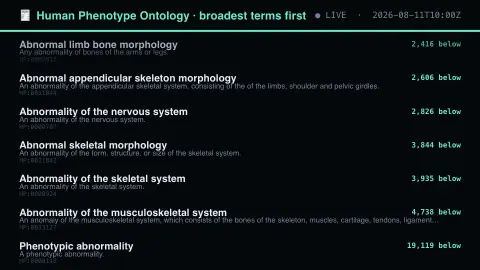
The The Words For What Is Wrong screensaver shows terms from the Human Phenotype Ontology, key-less. The descendant count is the honest measure of how broad a term is — how many more specific phenotypes sit beneath it. Terms with no definition are dropped, and the 8.4 MB term list is why this is a pipeline job. It's free, runs in your browser, and ESC exits.
Live preview
Press ESC to leave fullscreen. Settings are saved in your browser only.
How the The Words For What Is Wrong screensaver works
The saver reads the source described above and draws it on a canvas — no account, no tracking.
Terms from the Human Phenotype Ontology, key-less. The descendant count is the honest measure of how broad a term is — how many more specific phenotypes sit beneath it. Terms with no definition are dropped, and the 8.4 MB term list is why this is a pipeline job.
It refreshes on a schedule, so what you see stays current.
Colours can be changed in settings; nothing is stored beyond your own browser.
How the Human Phenotype Ontology is organised
A phenotype is an observable trait, and in medicine the word usually refers to an abnormal one, such as short stature, seizures or an unusually shaped ear. The Human Phenotype Ontology (HPO) was created in 2008 at the Charité in Berlin and is developed as part of the Monarch Initiative. It provides a standard vocabulary of phenotypic abnormalities seen in human disease, so clinicians and databases can describe the same finding with the same term.
Terms are arranged in a hierarchy, where each has an identifier of the form HP:0000118 and may have more specific children below it. That example is the root-level term 'Phenotypic abnormality', under which the other abnormality branches sit. The descendants figure counts how many more specific terms sit beneath a term, so it measures breadth: broad categories such as abnormalities of a whole organ system have many descendants, while the most specific findings have none.
A standard vocabulary lets software compare patients' features and match them with hereditary diseases, which is how the ontology is used in clinical diagnostics and in mapping human phenotypes to those of model organisms. The ontology is revised as terms are added and reorganised, so counts shift between releases. This is a dictionary of descriptions, not a list of diagnoses, and a term's presence says nothing about frequency or severity.
A worked example
Terms from the Human Phenotype Ontology, key-less. The descendant count is the honest measure of how broad a term is — how many more specific phenotypes sit beneath it. Terms with no definition are dropped, and the 8.4 MB term list is why this is a pipeline job.
Settings & tips
- Accent and Background recolour the display.
- Every value on screen comes from the live source — nothing is simulated.
- Press ESC to leave fullscreen.
Frequently asked questions
- Is this real data?
- Yes — it comes from the source named on this page and is refreshed on a schedule.
- Is a key needed?
- No. This source is fully key-less.
- Is it free?
- Yes, and it runs entirely in your browser.
- Is a phenotype the same as a disease?
- No. A phenotype is a single observable feature, while a disease is a pattern of features with an underlying cause.
- What does the descendant count measure?
- How many more specific terms lie beneath a term in the hierarchy, which indicates how general it is.
- Why does each term have an identifier?
- Identifiers such as HP:0000118 are stable codes, so systems can exchange data without depending on how a term is worded or translated.