What They Call It Screensaver
The What They Call It screensaver pairs the clinical name of a condition with the consumer name for the same thing — the vocabulary clinicians pick from in electronic health records, alongside the words patients actually use. It runs in the browser with nothing to install; press ESC to exit.
Live preview
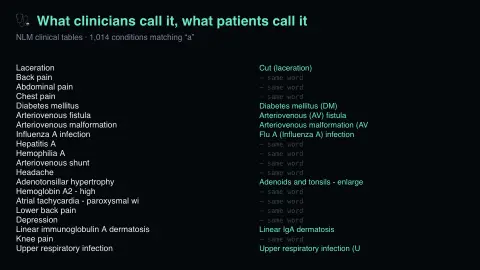
Press ESC to leave fullscreen. Settings are saved in your browser only.
How the What They Call It screensaver works
The saver reads The National Library of Medicine's Clinical Table Search Service, key-free.
No account and no key: the request goes straight from your browser, or from this site's own refreshed copy of the feed where the source does not permit browser access.
Values are drawn on a canvas that resizes with the window, so it works on a laptop or a wall display.
If the source is unreachable the saver says so on screen rather than showing stale numbers as though they were current.
Two vocabularies for one condition
Medicine has long used Greek and Latin roots to build precise, international terms. Cardio relates to the heart, myo to muscle, and itis to inflammation, so a clinician can assemble or decode a long word piece by piece. The result is exact among professionals but can sound opaque to everyone else, who say heart attack, high blood pressure or stomach flu.
Health informatics has to connect the two. The National Library of Medicine's Clinical Table Search Service offers a free medical conditions table, derived from the Regenstrief Institute's Medical Gopher program, with over 2,400 conditions. Each record has a primary_name and a consumer_name, described as a more consumer-friendly version of the primary name, along with ICD-10-CM codes and synonyms.
Pairs are not always perfect synonyms. A lay phrase can cover several clinical conditions, or a clinical term can be narrower than the everyday word, and some conditions have more than one common name. The screensaver is a glimpse of this vocabulary, not a diagnostic or medical reference, and nothing shown replaces advice from a health professional.
A worked example
Two columns: the clinical term on the left, the consumer term on the right where one differs. “Myocardial infarction” and “heart attack” are the same row. Where the two are identical the right column says so. The search rotates through the alphabet so the list keeps moving rather than sitting on one letter.
Settings & tips
- Accent and Background recolour the display without changing the data.
- Add it to a Multi-view grid to watch it alongside other live savers.
- Press ESC at any time to leave fullscreen.
Frequently asked questions
- Why do two names exist?
- Because precision and comprehension pull in different directions. Clinical vocabulary must distinguish conditions unambiguously for records and billing; patient-facing vocabulary must be understood. Health record systems increasingly carry both.
- Is this a diagnostic tool?
- No. It is a terminology reference showing how conditions are named. It contains no clinical guidance and should not be used to interpret symptoms.
- Is this real data?
- Yes. It comes from The National Library of Medicine's Clinical Table Search Service, key-free. Nothing is invented or simulated, and if the source cannot be reached the saver reports that instead of drawing something plausible.
- Does it cost anything or need an account?
- No. Every screensaver here is free, runs in the browser and needs no sign-up. This one uses a public API that requires no key.
- Why do doctors use Latin and Greek terms?
- Classical roots gave medicine a stable, international vocabulary in which parts of a word can be combined to describe what is affected and how.
- Are the clinical and everyday names exact equivalents?
- Not always. A common phrase may cover several conditions or a broader or narrower idea than the clinical term, so the pairing is an approximation.
- What is a consumer-friendly name?
- In the National Library of Medicine's conditions table it is a field holding a more consumer-friendly version of the condition's primary name.