The Cancer Archive Screensaver
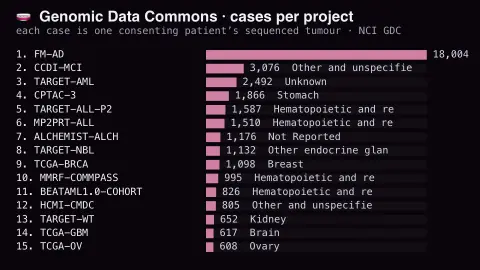
The Cancer Archive screensaver ranks projects in the NCI Genomic Data Commons by case count — the number of patients whose tumours were sequenced and whose data was made available to any researcher. It runs in the browser with nothing to install; press ESC to exit.
Live preview
Press ESC to leave fullscreen. Settings are saved in your browser only.
How the The Cancer Archive screensaver works
The saver reads The NCI Genomic Data Commons API, key-free.
No account and no key: the request goes straight from your browser, or from this site's own refreshed copy of the feed where the source does not permit browser access.
Values are drawn on a canvas that resizes with the window, so it works on a laptop or a wall display.
If the source is unreachable the saver says so on screen rather than showing stale numbers as though they were current.
Inside the Genomic Data Commons
The Genomic Data Commons (GDC) is a research program of the US National Cancer Institute, part of the National Institutes of Health, built as a unified repository and knowledge base for cancer research. Its aim is to let results from different genomic studies be compared directly. Datasets from The Cancer Genome Atlas (TCGA) and TARGET were processed with a common set of bioinformatics pipelines and aligned to a common reference genome, and the GDC generates higher-level data such as variant calls and expression quantifications.
Data are organised by program and then by project, with project identifiers that join the two, such as TCGA-LAML. A case is a study participant: a case's identifier corresponds to the participant's subject ID in the project's dbGaP records, so a project's case count is the number of people whose data it holds.
Access is split into open and controlled. Controlled-access files primarily include raw sequencing data such as BAM or FASTQ files, VCF files and protected MAF files, and using them requires authorisation through dbGaP; the split follows the informed consent of participants. The ranking therefore reflects the size of research projects, not how common each cancer is or how patients fared.
A worked example
Fifteen projects ranked by case count, each with its project code and primary tumour site. TCGA, TARGET and CPTAC dominate the top. Each case is one person who consented to have their tumour sequenced and the result shared, which is worth holding in mind while reading a bar chart of them.
Settings & tips
- Accent and Background recolour the display without changing the data.
- Add it to a Multi-view grid to watch it alongside other live savers.
- Press ESC at any time to leave fullscreen.
Frequently asked questions
- What is the Genomic Data Commons?
- The US National Cancer Institute's repository for the large public cancer genomics programmes. It holds sequencing and clinical data under controlled and open access tiers, and publishes summary counts openly.
- Why did the counts come back empty at first?
- Because the API returns case_count as null unless expand=summary is requested. It is a good example of an endpoint that will happily serve you a convincing-looking board of nothing.
- Is this real data?
- Yes. It comes from The NCI Genomic Data Commons API, key-free. Nothing is invented or simulated, and if the source cannot be reached the saver reports that instead of drawing something plausible.
- Does it cost anything or need an account?
- No. Every screensaver here is free, runs in the browser and needs no sign-up. This one uses a public API that requires no key.
- What is a case in the GDC?
- A case is one study participant in a project, matched to the participant's subject ID in the project's dbGaP records. A single case can have many data files.
- Is all the data openly downloadable?
- No. The GDC divides data into open and controlled access. Controlled files, mainly raw sequencing data such as BAM and FASTQ files, require dbGaP authorisation.
- Does a bigger project mean a more common cancer?
- Not necessarily. Case counts reflect how a research programme was designed and funded, so they do not measure how many people develop that cancer.