Maze Muncher: Lady Screensaver
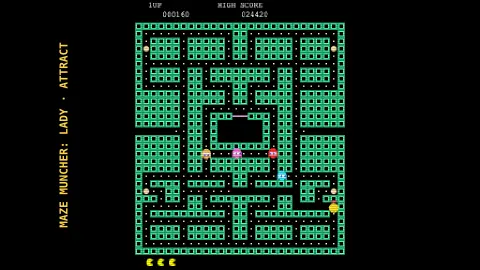
Maze Muncher: Lady is a self-playing arcade screensaver inspired by the 1981 sequel to the maze chase. It adds a bow, shifting maze colours and roaming bonus fruit. It's a free, original homage, runs in your browser, and ESC exits.
Live preview
Press ESC to leave fullscreen. Settings are saved in your browser only.
How the Maze Muncher: Lady screensaver works
The Lady variant is an original tribute to the 1981 follow-up to the maze-chase classic — original art, maze and name throughout.
Like the original muncher it plays itself, clearing the dots while the four ghosts chase and scatter.
It wears a bow, the maze takes on different colours, and bonus fruit wanders the corridors rather than sitting still.
Power pellets still flip the chase, turning the ghosts frightened blue for a few seconds.
Arcade sequels and the tribute tradition
The maze-chase genre was defined by Pac-Man, a Namco arcade game released in Japan on 22 May 1980 in which a yellow character eats dots while avoiding four coloured ghosts. Its success led to a famous arcade story: General Computer Corporation, a firm founded by MIT students, built an enhancement kit called Crazy Otto. After a settlement with Atari barred it from selling conversion kits without the original maker's consent, GCC showed the finished game to Midway, which bought the rights and released it as a sequel with a female lead.
The sequel's changes are the ones usually remembered. It had four maze colour schemes instead of one, some with two sets of warp tunnels, and its fruit bounced around the maze instead of sitting at the centre. Ghost movement became semi-random, which stopped players clearing a round by memorising a fixed pattern. The original's ghosts follow deterministic rules, with Blinky chasing directly while Pinky and Inky try to get in front of Pac-Man.
This page is an original piece inspired by that lineage, with its own artwork, mazes and name, and it is not the commercial game. Game designers still study maze-chase games for how a few simple enemy rules produce tension.
A worked example
The bow-wearing muncher clears a pink-walled maze as a cherry drifts through the tunnels; the ghosts close in, a power pellet flashes them blue, and she chases them down before the board resets in a fresh colour.
Settings & tips
- It runs itself in attract mode, like an arcade demo screen.
- Watch the bonus fruit roam the maze instead of staying put.
- The maze changes colour between boards, just like the sequel.
Frequently asked questions
- Is this Ms. Pac-Man?
- No. It's an original homage inspired by the 1981 sequel, with its own art, maze and name — nothing copyrighted is copied.
- How is it different from Maze Muncher?
- It adds the sequel's touches — a bow, colour-shifting mazes and roaming bonus fruit — over the same chase.
- Can I play it myself?
- Right now it runs in self-playing attract mode, like an arcade demo screen. A keyboard-playable mode may be added later.
- Does it need a connection?
- No. It's computed entirely on your device, so it runs fully offline.
- Is it free?
- Yes — free, no download, in your browser.
- What did the sequel change about ghost behaviour?
- Ghost movement became semi-random, so a memorised route could no longer clear a round. Players had to react to what the ghosts were doing instead of repeating a pattern.
- How did the sequel's fruit differ?
- The fruit bounced around the maze and entered and left through the warp tunnels, rather than appearing in the centre as in the original.
- What is a maze-chase game?
- It is a genre where the player navigates a maze collecting items while enemies pursue. Pac-Man, released in 1980, is the best-known example.