Iso Raider Screensaver
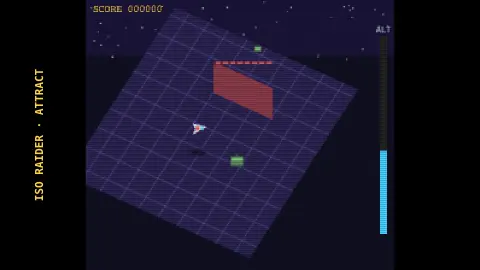
Iso Raider is a self-playing arcade screensaver inspired by the 1982 isometric shooter. The ship clears walls by altitude, read from its ground shadow and altitude bar, and strafes turrets and fuel tanks. It's a free, original homage, runs in your browser, and ESC exits.
Live preview
Press ESC to leave fullscreen. Settings are saved in your browser only.
How the Iso Raider screensaver works
Iso Raider is an original tribute to the isometric diagonal-scrolling shooter — original art and name throughout.
The fortress floor scrolls diagonally in a 3-D isometric view as the ship flies over it.
The ship's height is shown two ways — an altitude bar on the side and a shadow cast straight down onto the floor — so it can judge when to climb over a wall.
A self-playing pilot raises altitude to clear the walls, drops low to strafe turrets and fuel tanks, and fires forward into the distance.
Isometric shooters and the shadow trick
Isometric projection is a drawing method from technical and engineering illustration. It is a form of axonometric projection in which the three axes appear equally foreshortened and any two of them meet at 120 degrees, so the outline of a cube becomes a regular hexagon. Because it is a parallel projection, objects keep the same size however far away they are, which suits measurement but looks unnatural to the eye.
That property creates the problem the genre had to solve: on screen, a point can be high or it can be further back, and the picture alone does not say which. Sega’s Zaxxon, which reached arcades from late 1981 into 1982, was one of the first games to use axonometric projection. Its ship casts a shadow and the screen shows an altimeter, and together they let players judge height when flying through the walls of a fortress.
Many games described as isometric are not strictly so. Dimetric projection with a 2:1 pixel ratio is the most common approach, because lines at that slope draw cleanly on a pixel grid. The shadow-and-altitude idea, though, works in either variant: the gap between craft and shadow reads as height.
A worked example
The ship skims the isometric fortress, its shadow tracking beneath it; a tall wall approaches, the altitude bar rises as it climbs over, then it dips low to strafe a fuel tank that bursts in a shower of sparks.
Settings & tips
- It runs in attract mode — the ship flies and fires on its own.
- Read the ground shadow and altitude bar to judge the ship's height.
- It climbs for walls and dives to hit ground targets.
Frequently asked questions
- Is this Zaxxon?
- No. It's an original homage inspired by the 1982 isometric shooter, with its own art and name — nothing copyrighted is copied.
- How do I tell how high the ship is?
- Two cues: the altitude bar on the side, and the ship's shadow on the floor — the bigger the gap, the higher it flies.
- Can I play it myself?
- Right now it runs in self-playing attract mode, like an arcade demo screen. A keyboard-playable mode may be added later.
- Does it need a connection?
- No. It's computed entirely on your device, so it runs fully offline.
- Is it free?
- Yes — free, no download, in your browser.
- What is isometric projection?
- It is a way of drawing three-dimensional objects in which the three axes are equally foreshortened and meet at 120 degrees to each other. It is a parallel projection, so there is no vanishing point and size does not change with distance.
- Why is height hard to judge in this view?
- Because distance does not shrink objects, a flat picture cannot tell a high object from one that is further back. A ground shadow and an altitude gauge supply the missing cue.
- Are isometric video games truly isometric?
- Usually not. Games labelled isometric most often use a dimetric projection with a 2:1 pixel ratio, which is easier to draw cleanly on a pixel grid.