Maze Muncher Screensaver
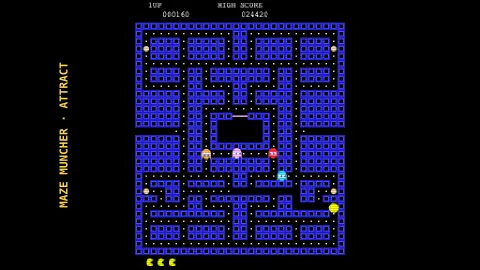
Maze Muncher is a self-playing arcade screensaver inspired by the 1980 maze-chase classic. A muncher clears the dots while four ghosts chase, scatter and turn blue on power pellets. It's a free, original homage, runs in your browser, and ESC exits.
Live preview
Press ESC to leave fullscreen. Settings are saved in your browser only.
How the Maze Muncher screensaver works
Maze Muncher is an original tribute to the maze-chase arcade classic — the art, the maze and the name are all original, so nothing copyrighted is reproduced.
The muncher plays itself, pathfinding through an original maze to eat the dots while keeping clear of the ghosts.
Each ghost has its own personality — one chases directly, one cuts ahead, one hangs back — and they alternate between chasing and scattering to the corners.
Eat a flashing power pellet and the ghosts turn frightened blue for a few seconds, and the muncher turns the tables.
Ghost personalities and the maze-chase genre
Maze-chase games became a defining arcade genre at the start of the 1980s, with the player collecting dots in a closed maze while enemies patrol. The famous original was developed by Namco and released in Japan in 1980, reaching North America that October. Its designer, Toru Iwatani, aimed for a nonviolent, cheerful game that would appeal beyond the usual arcade audience, and he built it around eating.
Its enemies had distinct behaviour rather than random wandering. In the original, one ghost chases the player directly, two try to get in front, and the fourth switches between chasing and fleeing depending on its distance. Fan analyses describe how each ghost aims at a target tile, and how the ghosts alternate between scatter mode, where they head for the corners of the maze, and chase mode.
The movement rule is simple grid pathfinding. At each intersection a ghost considers the exits that are not walls and not behind it, and picks the one whose next tile is nearest the target by straight-line distance, breaking ties in a fixed order. Because it never reverses, it is cheap to compute, deterministic and exploitable by skilled players.
A worked example
The muncher weaves the corridors gobbling dots, the four ghosts closing in from their corners; it grabs a power pellet, the ghosts flash blue and scatter, and it chases them down for bonus points before the maze clears and resets.
Settings & tips
- It runs in attract mode — the game plays itself, like an arcade demo screen.
- Watch the ghosts switch between chasing the muncher and scattering to their home corners.
- Power pellets briefly turn the hunters into the hunted.
Frequently asked questions
- Is this Pac-Man?
- No. It's an original homage inspired by the 1980 maze-chase classic, with its own art, maze and name — nothing copyrighted is copied.
- Can I play it myself?
- Right now it runs in self-playing attract mode, like an arcade demo screen. A keyboard-playable mode may be added later.
- Does it need a connection?
- No. It's computed entirely on your device, so it runs fully offline.
- Why do the ghosts behave differently?
- Each ghost has its own chase style and they periodically scatter — the behaviour that made the original so compelling.
- Is it free?
- Yes — free, no download, in your browser.
- How do the ghosts pick which way to go?
- At each intersection a ghost chooses, from the exits that are not walls and not behind it, the one that brings it nearest its target tile by straight-line distance. Each ghost uses a different target, which creates distinct behaviours.
- What are scatter and chase modes?
- They are alternating phases using the same pathfinding. In chase mode the ghosts aim at the player, while in scatter mode each aims at a fixed point outside the maze and so circles a corner.
- Who designed the original maze-chase game?
- Toru Iwatani at Namco, released in 1980. He aimed for a nonviolent, cheerful game with broad appeal, built around eating.