Marathon World Records Timeline Screensaver
The Marathon World Records Timeline screensaver shows the real progression of the marathon world record over more than a century, from the sport's own published results. It is free, runs in your browser, and ESC exits.
Live preview
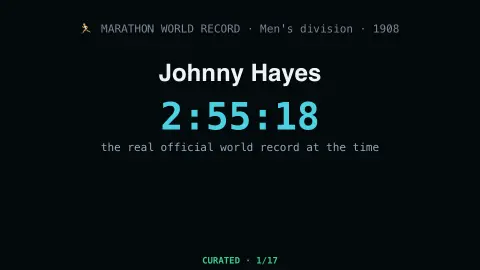
Press ESC to leave fullscreen. Settings are saved in your browser only.
How the Marathon World Records Timeline screensaver works
The saver displays a real, curated timeline of every marathon world record since official record-keeping began.
Each entry shows the real runner, real time and real year the record was set.
The timeline refreshes periodically as new real records are added.
No live feed is required — the timeline is a real, curated historical record.
A century of marathon world records
The marathon distance, 42.195 kilometres, was standardised in 1921 by the IAAF, now World Athletics. Before that, race distances varied, so early marathon times are not strictly comparable. The first record recognised by the IAAF was Johnny Hayes’ 2:55:18 at the 1908 London Olympics.
The record has fallen steadily, from just under three hours in 1908 to a little over two hours today. The improvements came from several sources: full-time professional training, coaching and nutrition, the entry of East African distance running, better course measurement, pacing and, in recent years, carbon-plated shoes. Fast, flat courses with organised pacers have produced many modern records.
Two details matter when reading the timeline. A record is ratified only if the course meets the sport’s criteria, which include a 42.195 km distance measured by the calibrated bicycle method and limits on the drop in elevation and on how far apart start and finish may be. Eliud Kipchoge’s 1:59:40 in Vienna in 2019 did not count as a record because of its setup, with a pace car and rotating pacers. And men’s and women’s records are kept separately, with different progressions.
A worked example
The real steady decline in the marathon world record time, from over 2:55 in the early 1900s to under 2:01 today, plays out across the timeline.
Settings & tips
- Accent recolours the timeline markers.
- Times and dates are real, ratified world records.
- Men's and women's records are both tracked separately.
Frequently asked questions
- Is this real record data?
- Yes — real, ratified marathon world records through history.
- Is a key needed?
- No — the timeline is a curated real record.
- Does it include the current record?
- Yes — the current real world record is included as the latest entry.
- Is it free?
- Yes — free, no download, in your browser.
- Why is the marathon exactly 42.195 km?
- The length comes from the 1908 London Olympic course. The IAAF standardised the distance at 42.195 km in 1921; before that, race distances varied.
- Why was Kipchoge’s sub-two-hour run not a world record?
- His 1:59:40 in Vienna in 2019 was not ratified under IAAF rules because of the setup of the challenge, which included a pace car and rotating pacers.
- Why are some early records hard to compare?
- Before the distance was standardised, courses varied in length and surface, so a faster time did not always mean a faster runner.