Who Built The Hardware Screensaver
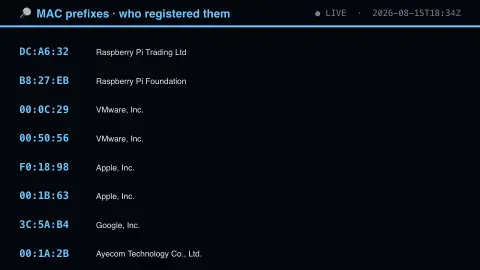
The Who Built The Hardware screensaver shows well-known MAC address prefixes alongside the companies that registered them — the Organisationally Unique Identifiers every networked device broadcasts. It runs in the browser with nothing to install; press ESC to exit.
Live preview
Press ESC to leave fullscreen. Settings are saved in your browser only.
How the Who Built The Hardware screensaver works
The saver reads api.macvendors.com, refreshed through this site's pipeline.
No account and no key: the request goes straight from your browser, or from this site's own refreshed copy of the feed where the source does not permit browser access.
Values are drawn on a canvas that resizes with the window, so it works on a laptop or a wall display.
If the source is unreachable the saver says so on screen rather than showing stale numbers as though they were current.
How MAC address prefixes identify makers
A MAC address is a six-byte hardware identifier for a network interface, written as six pairs of hexadecimal digits. The first three bytes form an Organizationally Unique Identifier, or OUI, a 24-bit globally unique number that the IEEE Registration Authority assigns to an organisation. The remaining bytes are assigned by that organisation to individual interfaces.
Lookup services map the prefix back to the registrant’s name. The result is the organisation that registered the prefix, which is not always the brand on the product, and IEEE states that assignments should not be used on a per-product basis. The IEEE also assigns smaller blocks: a medium block of about a million addresses, and a small block called MA-S (formerly OUI-36) of 4,096 addresses identified by 36 bits. For those, the first three bytes alone may not identify the registrant.
The prefix reveals only a registrant, not the model, owner or location. Addresses can also be changed in software, and some devices randomise them for privacy, so a vendor name next to a prefix is a hint rather than proof of what a device really is.
A worked example
Each row pairs a three-byte prefix with the organisation that bought it from the IEEE. B8:27:EB is a Raspberry Pi. 00:50:56 is a VMware virtual machine. 52:54:00 is QEMU. Any device on any network announces its manufacturer to anyone listening, which is a small permanent privacy fact and the reason phones now randomise the address they broadcast.
Settings & tips
- Accent and Background recolour the display without changing the data.
- Add it to a Multi-view grid to watch it alongside other live savers.
- Press ESC at any time to leave fullscreen.
Frequently asked questions
- What is an OUI?
- An Organisationally Unique Identifier: the first three bytes of a MAC address, assigned by the IEEE to the company making the hardware. The remaining three bytes are chosen by that manufacturer.
- Why do phones randomise their address?
- Because a stable MAC address lets any nearby receiver track a device between locations. Modern phones present a different randomised address to each network to break that link.
- Is this real data?
- Yes. It comes from api.macvendors.com, refreshed through this site's pipeline. Nothing is invented or simulated, and if the source cannot be reached the saver reports that instead of drawing something plausible.
- Does it cost anything or need an account?
- No. Every screensaver here is free, runs in the browser and needs no sign-up. This one uses a public API that requires no key.
- Does the prefix tell me the exact device model?
- No. It identifies the organisation that registered the block, which may not be the brand you know. The IEEE says assignments should not be used on a per-product basis.
- Why do some vendors have longer prefixes?
- The IEEE also assigns smaller blocks than the standard 24-bit OUI, such as MA-S blocks of 4,096 addresses identified by 36 bits. For these the first three bytes alone are not enough to identify the registrant.
- Can a MAC address be faked?
- Yes. Operating systems can change the address they present, which is why it should not be used alone to prove a device’s identity.