Lightning Strike Map Screensaver
The Lightning Strike Map screensaver shows real lightning detected worldwide, streaming live from the Blitzortung community detector network over WebSocket. Each strike flashes at its true position on a world map and fades. It's free, runs in your browser, and ESC exits.
Live preview
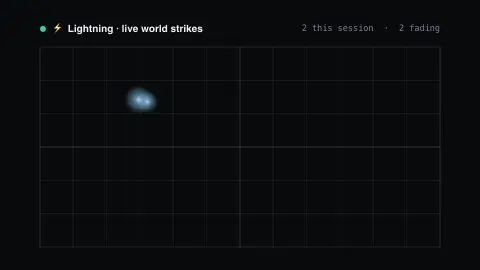
Press ESC to leave fullscreen. Settings are saved in your browser only.
How the Lightning Strike Map screensaver works
The saver reads Blitzortung directly in your browser — no key and no account.
Real lightning detected worldwide, streaming live from the Blitzortung community detector network over WebSocket.
It refreshes on a schedule, so what you see stays current.
Colours and the accent can be changed in settings; nothing is stored beyond your own browser.
How a volunteer network locates lightning
Blitzortung.org is a volunteer-run lightning detection network; its name combines the German words for lightning and location. Volunteers host small receivers with a VLF antenna and a GPS receiver. A lightning discharge radiates very low frequency radio energy that can be picked up far from the storm, and each station records the signal and stamps its arrival time to microsecond precision using GPS.
A single station cannot work out a position or even a direction from arrival times alone. Because the same pulse reaches different stations at slightly different instants, central servers can compare the times from several stations and compute where the discharge happened, a time-of-arrival method. The more stations hear a strike, the better the result. The positions are streamed to the saver as individual points, which is why each strike flashes at its place and fades.
The map is a picture of detection, not a complete census. Results depend on how many receivers are within range, so coverage and accuracy vary from region to region, and some strikes may be missed or placed less precisely where stations are sparse. The project itself describes the service as volunteer-run and not an official information source, so it should not be used for safety decisions.
A worked example
Real lightning detected worldwide, streaming live from the Blitzortung community detector network over WebSocket. Each strike flashes at its true position on a world map and fades.
Settings & tips
- Accent and Background recolour the display.
- Data comes straight from Blitzortung in your browser.
- Press ESC to leave fullscreen.
Frequently asked questions
- Is this real data?
- Yes — it comes from Blitzortung and is refreshed on a schedule.
- Is a key needed?
- No. This source is fully key-less.
- Does it need an internet connection?
- Yes — it reads a live source, so it needs a connection to update.
- Is it free?
- Yes — free, no download, in your browser.
- How does the network know where a strike is?
- Several receivers with GPS clocks record when the radio pulse arrives, and servers use the small differences in arrival time to compute the source location. One station alone cannot do this.
- Does it catch every strike?
- No. Detection depends on how many receivers are in range, so coverage differs between regions and some strikes are missed or placed less precisely.
- Is it an official lightning warning?
- No. Blitzortung is run by volunteers and says it is not an official information source, so do not rely on it for safety decisions.