LA Crime Reports Screensaver
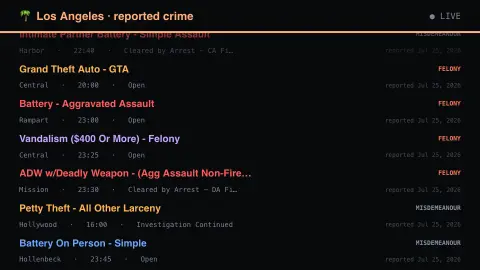
The LA Crime Reports screensaver shows reported offences from the City of Los Angeles key-less open-data portal: what was reported, which LAPD division, and when. The board shows the division only, never a street location. It's free, runs in your browser, and ESC exits.
Live preview
Press ESC to leave fullscreen. Settings are saved in your browser only.
How the LA Crime Reports screensaver works
The saver reads the City of Los Angeles open-data portal directly in your browser — no key and no account.
Reported crimes from the City of Los Angeles key-less open-data portal: what was reported, which part of the city, and when.
It refreshes on a schedule, so what you see stays current.
Colours can be changed in settings; nothing is stored beyond your own browser.
Reading the LAPD crime data
The City of Los Angeles runs an open-data portal where records from the Los Angeles Police Department are published. In the LAPD crime dataset each row has fields such as the date reported, the date occurred, the time, a crime description, the geographic area name, and details about the premises. Street addresses are given only to the nearest hundred block to protect privacy.
These are reports, not convictions. The portal notes that the data is transcribed from original crime reports, which can introduce inaccuracies, and that missing locations are recorded as 0°, 0°. LAPD also changed its records system in March 2024 to meet the FBI’s NIBRS-only requirement, so older and newer records are not always directly comparable. Counts also depend on what people choose to report and on how incidents are classified.
The LAPD divides the city into 21 geographic areas, each served by a community police station, and the area name is the coarsest location label in the data. Each row also carries a reporting district, a smaller sub-area. The board is not a measure of how safe a particular neighbourhood is.
A worked example
Reported offences from the City of Los Angeles key-less open-data portal: what was reported, which LAPD division, and when. The board shows the division only, never a street location.
Settings & tips
- Accent and Background recolour the display.
- Data comes straight from the City of Los Angeles open-data portal in your browser.
- Press ESC to leave fullscreen.
Frequently asked questions
- Is this real data?
- Yes — it comes from the City of Los Angeles open-data portal and is refreshed on a schedule.
- Does this show exact locations?
- No. Los Angeles publishes the reporting area rather than an address, and nothing more precise is derived here.
- Is a key needed?
- No. This source is fully key-less.
- Is it free?
- Yes — free, no download, in your browser.
- Why is there a gap between when a crime happened and when it was reported?
- The dataset records both the date a crime occurred and the date it was reported, and many incidents are reported after the fact, so the two can differ.
- Do the figures prove an area is dangerous?
- No. Counts depend on population, activity, reporting rates and classification, so a raw list cannot be used to compare safety.
- How precise are the locations?
- Addresses are rounded to the nearest hundred block to protect privacy, and the board shows only the LAPD area, never a street.