Chicago Crime Feed Screensaver
The Chicago Crime Feed screensaver shows real reported incidents from Chicago's key-less open-data portal — offence, description, arrest status and block. The city publishes location only to the block, never an exact address, and no personal details are in the feed. It's free, runs in your browser, and ESC exits.
Live preview
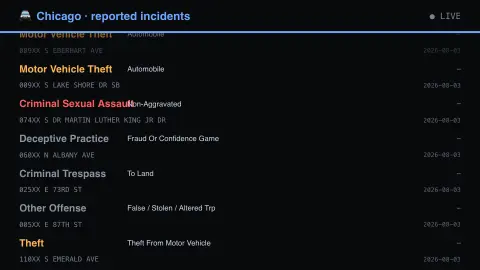
Press ESC to leave fullscreen. Settings are saved in your browser only.
How the Chicago Crime Feed screensaver works
The saver reads Chicago Open Data directly in your browser — no key and no account.
Real reported incidents from Chicago's key-less open-data portal — offence, description, arrest status and block.
It refreshes on a schedule, so what you see stays current.
Colours can be changed in settings; nothing is stored beyond your own browser.
What reported crime data does and does not show
The City of Chicago publishes reported crime incidents on its open-data portal in a dataset titled "Crimes - 2001 to Present", with the Chicago Police Department as the stated source. The data comes from the department's CLEAR system. Each record carries a date, an Illinois Uniform Crime Reporting (IUCR) code with a primary type and a more detailed description, a location description, whether an arrest was made, whether the incident was domestic-related, and a block.
The block is a partially redacted address on the same block as the real one, and the map coordinates are shifted in the same way, so an exact building cannot be pinpointed. The portal says the data are updated daily but leave out the most recent seven days, and that murders are excluded except where victim-level data exists.
These are reported incidents, not all crime that occurs. The city labels the data preliminary: classifications may change and accuracy is not guaranteed. A block that appears often can reflect its size, foot traffic or reporting habits, so the feed is a window onto police records, not a measure of how safe any neighbourhood is.
A worked example
Real reported incidents from Chicago's key-less open-data portal — offence, description, arrest status and block. The city publishes location only to the block, never an exact address, and no personal details are in the feed.
Settings & tips
- Accent and Background recolour the display.
- Data comes straight from Chicago Open Data in your browser.
- Press ESC to leave fullscreen.
Frequently asked questions
- Is this real data?
- Yes — it comes from Chicago Open Data and is refreshed on a schedule.
- Does this identify anyone?
- No. The city publishes location only to the block and includes no victim or suspect details. Nothing is added here beyond what the city releases.
- Is a key needed?
- No. This source is fully key-less.
- Is it free?
- Yes — free, no download, in your browser.
- Does an arrest mean the person was convicted?
- No. The arrest field records only whether an arrest was made in connection with the incident. It says nothing about charges or what a court decided.
- Why is location given only to the block?
- The city describes the address as partially redacted to the block level to protect victim privacy, so you can see the block but not the exact building.
- Can I tell if a neighbourhood is safe from this?
- Not reliably. The list shows reported incidents without population or circumstances, the data are preliminary, and some records are excluded, so it cannot rate how safe a place is.