Fire & EMS Dispatch Screensaver
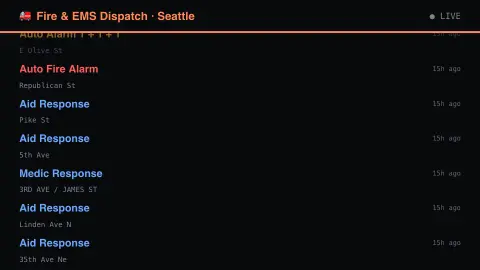
The Fire & EMS Dispatch screensaver shows real fire and medical dispatches from a city's own key-less open-data feed, as they are logged. Street numbers are stripped before display, so the block is shown but not the individual address. It's free, runs in your browser, and ESC exits.
Live preview
Press ESC to leave fullscreen. Settings are saved in your browser only.
How the Fire & EMS Dispatch screensaver works
The saver reads the city's own open-data portal directly in your browser — no key and no account.
Real fire and medical dispatches from a city's own key-less open-data feed, as they are logged.
It refreshes on a schedule, so what you see stays current.
Colours can be changed in settings; nothing is stored beyond your own browser.
What a dispatch log records
When someone calls emergency services, a dispatcher classifies the call, assigns it a type and sends units. Many cities publish records of these assignments in an open-data portal, typically a table with an incident type, a time and a rough location. In many places fire departments also respond to medical emergencies, so a fire dispatch log can mix fires, rescues, alarms and emergency medical calls.
The type recorded usually reflects the initial classification based on what the caller reports, and it can differ from what responders find on arrival. A call coded as a structure fire may turn out to be a false alarm, and a general medical call might be a minor issue. Some portals log one row per unit sent, so a single incident can create several entries; this varies from city to city, so check the portal's documentation.
What such a log does not show is just as important. It does not identify people, and it typically carries no outcome, severity or medical detail. Publication practices differ between cities, and this saver strips street numbers, which is why only a block or area is shown. A busy list reflects call volume and not the number of serious incidents.
A worked example
Real fire and medical dispatches from a city's own key-less open-data feed, as they are logged. Street numbers are stripped before display, so the block is shown but not the individual address.
Settings & tips
- Accent and Background recolour the display.
- Data comes straight from the city's own open-data portal in your browser.
- Press ESC to leave fullscreen.
Frequently asked questions
- Is this real data?
- Yes — it comes from the city's own open-data portal and is refreshed on a schedule.
- Does this show exact addresses?
- No. The city publishes the address, but the street number is stripped before display, so you see the block and street rather than an individual home.
- Is a key needed?
- No. This source is fully key-less.
- Is it free?
- Yes — free, no download, in your browser.
- Why can one incident appear more than once?
- Some open-data logs record each unit dispatched, so an incident with several responding units can create several rows. Whether a city does this depends on its own system.
- Are the incident types always accurate?
- They typically reflect the initial classification from the call, so what responders find on scene can be different.
- Why do medical calls appear in a fire log?
- In many places the fire department also responds to medical emergencies, so both kinds of call can appear in the same dispatch records.