What Kubernetes Runs On Screensaver
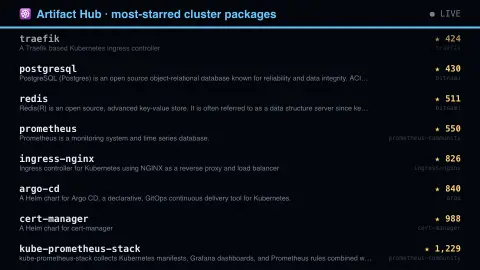
The What Kubernetes Runs On screensaver shows the most-starred packages on Artifact Hub, key-less. Almost everything at the top is infrastructure that exists to watch other infrastructure — metrics stacks, certificate managers, ingress controllers, deployment tooling. It is a fair portrait of what running a cluster costs in moving parts before a single application is deployed. It's free, runs in your browser, and ESC exits.
Live preview
Press ESC to leave fullscreen. Settings are saved in your browser only.
How the What Kubernetes Runs On screensaver works
The saver reads the source described above and draws it on a canvas — no account, no tracking.
The most-starred packages on Artifact Hub, key-less. Almost everything at the top is infrastructure that exists to watch other infrastructure — metrics stacks, certificate managers, ingress controllers, deployment tooling. It is a fair portrait of what running a cluster costs in moving parts before a single application is deployed.
It refreshes on a schedule, so what you see stays current.
Colours can be changed in settings; nothing is stored beyond your own browser.
What Artifact Hub catalogues
Artifact Hub is a web application for finding, installing and publishing cloud-native packages, and it is a Cloud Native Computing Foundation Sandbox project. Its documentation lists many repository kinds beyond Helm charts, the packaging format for Kubernetes applications, including OLM operators, Tekton tasks, Falco rules, OPA policies, Kyverno policies and container images.
Each package page shows its publisher, a description and a version, and signed-in users can star packages. The ranking on this display follows those stars, so it reflects popularity among people who use the site rather than install counts, quality or security posture. Stars accumulate over years, so long-established projects tend to hold the top.
The same software is often published from more than one repository, so near-duplicates can appear. Artifact Hub marks a publisher as verified when it has proved it owns the repository, and an official badge is a further step that requires verified status first. Artifact Hub also publishes security reports for packages, but this display shows only the headline fields.
A worked example
The most-starred packages on Artifact Hub, key-less. Almost everything at the top is infrastructure that exists to watch other infrastructure — metrics stacks, certificate managers, ingress controllers, deployment tooling. It is a fair portrait of what running a cluster costs in moving parts before a single application is deployed.
Settings & tips
- Accent and Background recolour the display.
- Every value on screen comes from the live source — nothing is simulated.
- Press ESC to leave fullscreen.
Frequently asked questions
- Is this real data?
- Yes — it comes from the source named on this page and is refreshed on a schedule.
- Is a key needed?
- No. This source is fully key-less.
- Is it free?
- Yes, and it runs entirely in your browser.
- Does the star count equal downloads?
- No. Stars are marks given by site users, so they measure popularity on Artifact Hub, not how many times a chart has been installed.
- What is a Helm chart?
- It is a Helm package: a bundle of templates and default values that describes a set of Kubernetes resources, so an application can be installed and configured with the helm tool.
- Are the packages safe to install?
- Appearing on the hub is not a safety endorsement. Artifact Hub generates security reports for some packages, but you should review the source and publisher before deploying anything.