Kanji Stroke Order Screensaver
Kanji Stroke Order is a free screensaver that writes Japanese kanji one brush stroke at a time on a faint guide grid, beside the character's English meaning, on and kun readings, school grade and stroke count. It covers 256 characters, uses the stroke order recorded in the open KanjiVG dataset, and ESC exits.
Live preview
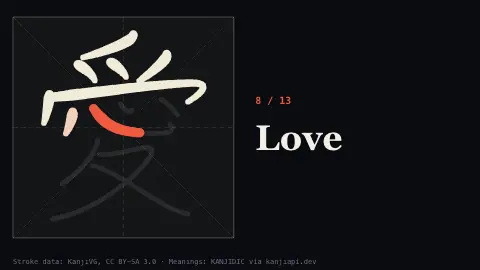
Press ESC to leave fullscreen. Settings are saved in your browser only.
How the Kanji Stroke Order screensaver works
Each character is a list of stroke paths taken from KanjiVG, a volunteer-made dataset that stores every stroke as a curve in a 109 by 109 box, numbered in writing order. The saver flattens each curve into a polyline, then reveals it along its length so the stroke is drawn from its start point to its tip, with the brush thinning toward the end.
The stroke being written is shown in the accent colour and fades to the stroke colour once it is finished; strokes still to come appear as a faint ghost. A counter shows how many strokes have been started, and a small number marks where the pen goes down. When the last stroke is done the finished character is held for a few seconds, then the next one starts.
The meaning, on and kun readings (kun readings use a dot to mark where the okurigana begins, as KANJIDIC writes them), school grade and stroke count come from KANJIDIC2 by way of kanjiapi.dev. A character is only included if the number of KanjiVG strokes equals the stroke count reported there; the page data is built once by a script, so the saver itself makes no network request to either service.
The 256 characters are the 80 grade 1 and 160 grade 2 kanji that Japanese children learn in the first two years of school, plus 16 well-known others such as 愛, 夢 and 桑. On a small tile the saver shows only the character, the stroke counter and the main meaning.
About the data and licences
Stroke shapes and stroke order come from KanjiVG (https://github.com/KanjiVG/kanjivg, kanjivg.tagaini.net), copyright 2009-2011 Ulrich Apel and contributors, released under the Creative Commons Attribution-Share Alike 3.0 licence. The paths on this site were rewritten into a more compact form with coordinates rounded to 0.1 of the original 109 by 109 box; the shapes are otherwise KanjiVG's. Because of the Share-Alike term, that rewritten stroke data is likewise available under CC BY-SA 3.0.
Meanings, readings, grade and stroke counts come from KANJIDIC2 through kanjiapi.dev. The KANJIDIC files are the property of the Electronic Dictionary Research and Development Group and are used under their Creative Commons Attribution-Share Alike 4.0 licence (https://www.edrdg.org/edrdg/licence.html). The kanjiapi.dev service itself credits the EDRDG as the source of this data. Only a few meanings and readings per character are shown, and KANJIDIC's radical-number entries (such as "river radical (no. 47)") are left out of the on-screen meanings.
A character appears only if the number of KanjiVG stroke paths matches the stroke count reported by kanjiapi.dev. All 256 characters tried passed that check. That check confirms the count, not the order or the shape of each stroke. The stroke order shown is the Japanese order as recorded by KanjiVG; some characters are written differently in China, Taiwan or Korea.
A worked example
愛 (love, affection, favourite) has 13 strokes and is a grade 4 kanji in KANJIDIC; its on reading is ai and its kun readings include itoshii and kanashii. Its 13th and last stroke is the long sweep to the lower right. 森 (forest, woods) is three 木 trees: 12 strokes, grade 1, read shin or mori. 学 (study, learning) takes 8 strokes and is also grade 1.
Settings & tips
- Characters picks grade 1, grade 2, all 256 in grade order, or all shuffled.
- Writing speed sets how fast each stroke is drawn and how long the finished character is held.
- Show guide grid toggles the dashed cross and diagonal guide lines used when practising writing.
- Show readings hides the on and kun readings if you want only the meaning.
- Press ESC to leave fullscreen.
Frequently asked questions
- Is this the correct stroke order?
- It is the stroke order recorded by KanjiVG, which records the Japanese order. KanjiVG is edited by volunteers and can contain mistakes, so use a textbook or dictionary when it matters. The saver does not check the order independently.
- Is stroke order the same in Chinese?
- Not always. Some characters are written with a different stroke order or shape in China, Taiwan or Korea. This saver shows the Japanese order and does not show regional variants.
- Where do the meanings and readings come from?
- From KANJIDIC2, the kanji dictionary file of the Electronic Dictionary Research and Development Group, via the key-less kanjiapi.dev service. Only up to three meanings and up to two on and two kun readings per character are shown, so they are not complete.
- Which kanji are included?
- The 80 grade 1 and 160 grade 2 kanji of the Japanese school list, plus 16 others chosen because they are well known. That is a small fraction of all Japanese kanji.
- What do the dots in the kun readings mean?
- They separate the part of a reading that is part of the character from the okurigana, the kana written after it. In いと.しい the しい is written in kana after the kanji. A hyphen marks a reading used as a prefix or suffix.
- Does it need an internet connection while running?
- No outside service is called while it runs. The characters are loaded from one data file on this site, which is refreshed rarely because the data does not change.
- Can I use it to learn to write kanji?
- It can show you the order and direction of each stroke, but it does not show stroke ends, stops and sweeps in detail and it does not check your writing, so treat it as a reference and not as a course.