Humanitarian Data Exchange Screensaver
The Humanitarian Data Exchange screensaver shows the datasets aid organisations have just published or refreshed on the Humanitarian Data Exchange, key-less. It's free, runs in your browser, and ESC exits.
Live preview
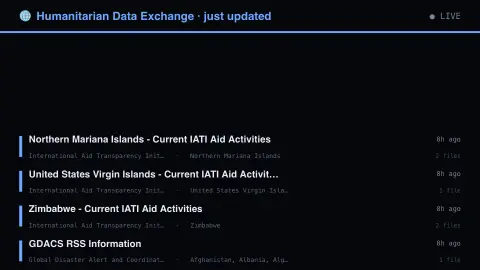
Press ESC to leave fullscreen. Settings are saved in your browser only.
How the Humanitarian Data Exchange screensaver works
The saver reads the source described above and draws it on a canvas — no account, no tracking.
The datasets aid organisations have just published or refreshed on the Humanitarian Data Exchange, key-less. This is the plumbing behind crisis response rather than the headlines: flood extents, displacement figures, operational presence.
It refreshes on a schedule, so what you see stays current.
Colours and any options can be changed in settings; nothing is stored beyond your own browser.
What the Humanitarian Data Exchange is
The Humanitarian Data Exchange, or HDX, is an open platform for sharing data about humanitarian crises. It is managed by the Centre for Humanitarian Data, part of the UN Office for the Coordination of Humanitarian Affairs (OCHA), based in The Hague, and it is built on CKAN, an open-source data-portal system. HDX launched in 2014, and its aim is to make humanitarian data easy to find and use for analysis.
Datasets on HDX come from many partner organisations and are mostly the working inventory of response work, often shared as spreadsheets such as CSV or Excel files. HDX promotes a data standard called HXL, the Humanitarian Exchange Language, which places hashtags between the column headers and the data so that software can process and combine datasets from different sources more easily.
The listing shows datasets that were newly added or recently refreshed, so a title may be an update to a long-running series and not a new event. A dataset appearing here does not mean a crisis is starting. Each dataset is published by an organisation that supplies its own description and terms, so check the individual dataset page before reusing it.
A worked example
The datasets aid organisations have just published or refreshed on the Humanitarian Data Exchange, key-less. This is the plumbing behind crisis response rather than the headlines: flood extents, displacement figures, operational presence.
Settings & tips
- Accent and Background recolour the display.
- Every number on screen comes from the live source — nothing is simulated.
- Press ESC to leave fullscreen.
Frequently asked questions
- Is this real data?
- Yes — it comes from the source named on this page and is refreshed on a schedule.
- Is a key needed?
- No. This source is fully key-less.
- Is it free?
- Yes — free, no download, in your browser.
- Who runs the Humanitarian Data Exchange?
- OCHA's Centre for Humanitarian Data manages it, while the data come from many partner organisations.
- What is HXL?
- The Humanitarian Exchange Language is a data standard for spreadsheet formats such as CSV or Excel. Its hashtags sit between the column headers and the data, which helps software process the data.
- Does a refreshed dataset mean a new crisis?
- Not necessarily. Many entries are updates to existing datasets rather than responses to a new event.