Five Stars, Whatever That Means Screensaver
The Five Stars, Whatever That Means screensaver shows cMS hospital overall star ratings, gathered key-less by the pipeline. It's free, runs in your browser, and ESC exits.
Live preview
Press ESC to leave fullscreen. Settings are saved in your browser only.
How the Five Stars, Whatever That Means screensaver works
The saver reads the source described above and draws it on a canvas — no account, no tracking.
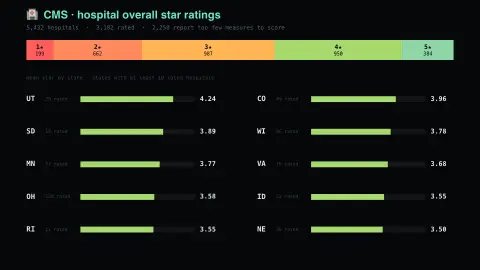
CMS hospital overall star ratings, gathered key-less by the pipeline. CMS compresses dozens of measures into one star and says plainly it is not a ranking, so this shows the national distribution and how much of the country is missing from it.
It refreshes on a schedule, so what you see stays current.
Colours and any options can be changed in settings; nothing is stored beyond your own browser.
How the CMS star rating is built
The Centers for Medicare & Medicaid Services publishes an Overall Hospital Quality Star Rating on Care Compare, a single summary of one to five stars. It combines many publicly reported quality measures, grouped into mortality, safety of care, readmission, patient experience, and timely and effective care. In recent versions the first four groups are each weighted 22 per cent and timely and effective care 12 per cent, and the weight of any missing group is redistributed across the others.
Hospitals are compared within peer groups defined by how many measure groups they report with at least three measures each, and are then assigned to one to five stars using k-means clustering. Because the groups are statistical, the stars are a summary and not a ranking, and strength in one specialty may not show in the overall star. The method has been revised over time, so ratings can move for reasons other than a change in care.
A hospital is rated only if it reports at least three measures in at least three measure groups, including mortality or safety of care. Care Compare shows “Not available” for hospitals with too few measures, which can include small, specialty or new facilities. A missing star is an absence of data, not a poor mark, and this screen shows the national distribution alongside the share with no rating.
A worked example
CMS hospital overall star ratings, gathered key-less by the pipeline. CMS compresses dozens of measures into one star and says plainly it is not a ranking, so this shows the national distribution and how much of the country is missing from it.
Settings & tips
- Accent and Background recolour the display.
- Every value on screen comes from the live source — nothing is simulated.
- Press ESC to leave fullscreen.
Frequently asked questions
- Is this real data?
- Yes — it comes from the source named on this page and is refreshed on a schedule.
- Is a key needed?
- No. This source is fully key-less.
- Is it free?
- Yes, and it runs entirely in your browser.
- Does a one-star hospital mean unsafe care?
- Not necessarily. The rating summarises many measures and hospitals are clustered into stars within peer groups, so it should be read as one indicator among several.
- Why are so many hospitals unrated?
- A hospital needs at least three measures in at least three measure groups, including mortality or safety of care. Hospitals with too few reported measures show no star.
- What goes into the star rating?
- Quality measures in five groups: mortality, safety of care, readmission, patient experience, and timely and effective care.