Global Physician Density Board Screensaver
The Global Physician Density Board screensaver ranks countries by real medical doctors per 10,000 population, from the WHO. It is free, runs in your browser, and ESC exits.
Live preview
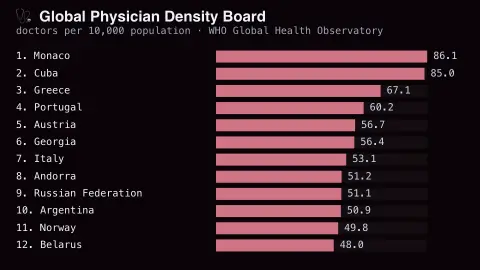
Press ESC to leave fullscreen. Settings are saved in your browser only.
How the Global Physician Density Board screensaver works
The saver reads real published physician-density figures from the WHO Global Health Observatory.
Countries are ranked by their real reported doctors-per-capita figure.
The pipeline refreshes the data on the source's own real reporting schedule.
No key is required for the published WHO data.
Counting doctors per 10,000 people
Physician density is the number of medical doctors per 10,000 people. The WHO definition covers generalists, specialist medical practitioners and doctors not further defined (ISCO-08 codes 221, 2211 and 2212). Most counts come from the WHO National Health Workforce Accounts platform, where countries report through nationally nominated focal points, and the WHO may also draw on the OECD-Eurostat-WHO Europe joint questionnaire or national administrative sources.
Comparisons need care. Depending on the original source, a figure may cover only practising doctors or all doctors registered in the occupation, and the indicator does not standardise this. Data are not published every year for every country, so the latest available figure is used and reference years can differ between rows. Coverage and completeness vary considerably, and public-sector records tend to be the most complete. Populations come from the UN Population Division’s World Population Prospects, so a ratio can differ from the one a country publishes itself.
The number is a national average. It says nothing about where doctors work, how many are specialists, or whether patients can reach them, so two countries with the same density can offer very different access to care. Small populations make the ratio sensitive to modest changes in the doctor count.
A worked example
A country with a real reported high physician density sits near the top of the ranked board, exactly matching the WHO's own published figure.
Settings & tips
- Figures are real WHO-reported national averages, not individual predictions.
- Accent recolours the ranking bars.
- Physician density figures update on WHO's own real reporting cycle.
Frequently asked questions
- Is this real health data?
- Yes — real published figures from the WHO Global Health Observatory.
- Is a key needed?
- No. WHO publishes this data freely.
- Does this reflect healthcare quality?
- No — it shows real doctor density only, not care quality.
- Is it free?
- Yes — free, no download, in your browser.
- Why are the years different between countries?
- Data are not published annually for every country, so the WHO uses the latest figure available for each one. Rows can therefore refer to different reference years.
- Does the figure count only practising doctors?
- Not necessarily. Depending on the original source, it may cover only practising doctors or all doctors registered in the occupation, and the WHO indicator does not standardise this.
- Where does the population figure come from?
- Densities use national population estimates from the UN Population Division’s World Population Prospects, so they can differ from the figures a country publishes itself.