HIV Prevalence Board Screensaver
The HIV Prevalence Board screensaver ranks real HIV prevalence among adults aged 15 to 49 by country. It is free, runs in your browser, and ESC exits.
Live preview
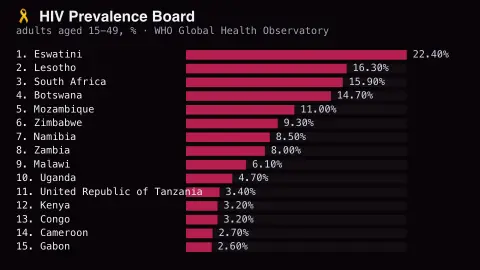
Press ESC to leave fullscreen. Settings are saved in your browser only.
How the HIV Prevalence Board screensaver works
The saver reads real HIV prevalence among adults aged 15 to 49 data from the WHO's own Global Health Observatory API.
Countries are ranked by their real latest reported HIV prevalence rate.
The pipeline refreshes on the WHO's own periodic release schedule.
No key is required for this key-less public endpoint.
What adult HIV prevalence does and does not show
Prevalence is the share of a population living with a condition at a given time. For HIV the standard international indicator covers adults aged 15 to 49, expressed as a percentage: the estimated number of adults in that age band living with HIV divided by the country’s population of the same ages. UNAIDS and WHO produce the estimates, and WHO publishes them through the Global Health Observatory.
The figures are modelled rather than counted, since not everyone is tested. UNAIDS fits epidemic curves to data such as HIV testing of pregnant women at antenatal clinics and nationally representative household surveys, and the Spectrum software then turns those curves into outputs like the number of people living with HIV. Clinic data show trends over time, while household surveys, which include men and people who do not use health services, anchor the level.
Prevalence should not be mistaken for the rate of new infections, which is a separate indicator called incidence. Effective antiretroviral treatment lets people live long lives with HIV, so prevalence can stay high or even rise while new infections fall and deaths decline. A high ranking describes the size of the population living with the virus, not the current speed of its spread or the quality of a country’s response.
A worked example
A real country's most recent reported HIV prevalence rate is ranked against the real others, with bars easing into place as the board loads.
Settings & tips
- Prevalence covers adults aged 15-49, the WHO's standard reporting age band.
- Accent recolours the bars and header text.
- Values and years are real, unedited WHO Global Health Observatory data.
Frequently asked questions
- Is this real health data?
- Yes — real HIV prevalence among adults aged 15 to 49 figures from the WHO's own Global Health Observatory API.
- Is a key needed?
- No. The GHO OData API is fully key-less.
- How often does it update?
- The pipeline re-reads the WHO's own dataset periodically, on whatever schedule WHO republishes that indicator.
- Is it free?
- Yes — free, no download, in your browser.
- Is prevalence the same as new infections?
- No. Prevalence counts everyone living with HIV, while incidence counts new infections in a period. The two can move in opposite directions.
- Why is the age range 15 to 49?
- It is the long-standing UNAIDS and WHO convention for the adult prevalence indicator, used as the denominator so countries can be compared on the same footing. It leaves out children and people aged 50 and over.
- Are these numbers measured or estimated?
- Estimated. UNAIDS and WHO use models fitted to clinic and household survey data, so each figure comes with uncertainty and may be revised in later rounds.