Healthcare Provider Registry Screensaver
The Healthcare Provider Registry screensaver shows real healthcare organisations on the CMS National Provider Identifier registry, gathered key-less by the pipeline. Organisation records only — no individual practitioners and no patient data. It's free, runs in your browser, and ESC exits.
Live preview
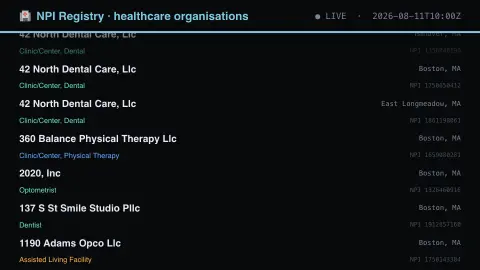
Press ESC to leave fullscreen. Settings are saved in your browser only.
How the Healthcare Provider Registry screensaver works
The background pipeline reads this from the CMS NPI registry and saves a snapshot the saver loads.
Real healthcare organisations on the CMS National Provider Identifier registry, gathered key-less by the pipeline.
It refreshes on a schedule, so what you see stays current.
Colours can be changed in settings; nothing is stored beyond your own browser.
The National Provider Identifier registry
In the United States, the National Provider Identifier is the 10-digit standard unique health identifier for health care providers. HIPAA required a standard identifier, and the NPI Final Rule of 2004 adopted it. CMS maintains the National Plan and Provider Enumeration System, NPPES, which assigns NPIs and stores all of them. Health plans, including Medicare and Medicaid, require NPIs in their administrative and financial transactions.
The registry separates providers into two types. Type 1 covers individual providers such as physicians and nurse practitioners. Type 2 covers health care organizations such as hospitals, nursing homes and physician groups, and an organization can hold multiple NPIs. This display restricts itself to the organisational type and shows a name, the kind of organisation and a practice location, which is the address given on the record.
A registry entry confirms that an identifier exists, not that an organisation is open, accredited or accepting patients. CMS notes that having an NPI does not ensure a provider is licensed or credentialed, or guarantee payment. Covered providers must report changes to their NPI information within 30 days, but records are maintained by the providers themselves, so details like addresses can still be out of date. The registry is a directory, not a quality rating or a recommendation.
A worked example
Real healthcare organisations on the CMS National Provider Identifier registry, gathered key-less by the pipeline. Organisation records only — no individual practitioners and no patient data.
Settings & tips
- Accent and Background recolour the display.
- Run
automation/run.py npiregistryto refresh the feed. - Press ESC to leave fullscreen.
Frequently asked questions
- Is this real data?
- Yes — it comes from the CMS NPI registry and is refreshed on a schedule.
- Is any patient data shown?
- None. NPI is a public directory of organisations that bill federal health programmes. Only organisation records are requested, so no practitioners appear either.
- Is a key needed?
- No. This source is fully key-less.
- Is it free?
- Yes — free, no download, in your browser.
- What is the difference between a Type 1 and a Type 2 NPI?
- Type 1 is for individual health care providers, such as physicians and nurse practitioners, and Type 2 is for organizations such as hospitals and physician groups. Only organisational records are shown here.
- Does being in the registry mean a provider is licensed?
- No. CMS states that having an NPI does not ensure a provider is licensed or credentialed.
- Why might an address be out of date?
- Providers maintain their own records, and an entry can lag behind a move or closure even though covered providers are required to report changes within 30 days.