The Data Behind The Papers Screensaver
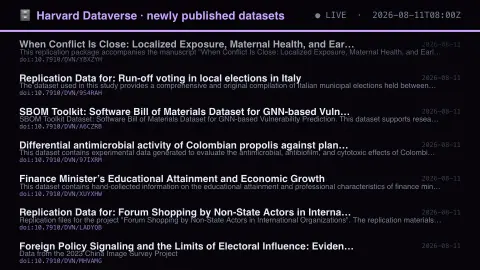
The The Data Behind The Papers screensaver shows datasets newly deposited to Harvard Dataverse, key-less. Replication packages are most of what lands here — the numbers and code behind a published result, released so someone else can re-run it — so the DOI is drawn as the citable thing. It's free, runs in your browser, and ESC exits.
Live preview
Press ESC to leave fullscreen. Settings are saved in your browser only.
How the The Data Behind The Papers screensaver works
The saver reads the source described above and draws it on a canvas — no account, no tracking.
Datasets newly deposited to Harvard Dataverse, key-less. Replication packages are most of what lands here — the numbers and code behind a published result, released so someone else can re-run it — so the DOI is drawn as the citable thing.
It refreshes on a schedule, so what you see stays current.
Colours can be changed in settings; nothing is stored beyond your own browser.
What replication data is for
Harvard Dataverse is a repository for research data. Harvard’s Institute for Quantitative Social Science (IQSS) leads development of the open-source Dataverse software, which other institutions also run, and Harvard Dataverse is the Harvard installation. Researchers can deposit datasets, and each published dataset receives a DOI, often of the form doi:10.7910/DVN/..., so it can be cited reliably.
Many deposits are titled Replication Data for: followed by a paper title. These packages contain the data files, and often the code, behind a published analysis so that other researchers can rerun or check the results. The saver shows what has just been published, a mix of large and tiny datasets, in no order of importance.
Deposit is not an endorsement. A dataset’s description is written by whoever uploaded it, and the repository does not vouch for the science; it offers optional curation services aimed at making datasets findable, accessible, interoperable and reusable. Some files can be restricted, so a listing does not mean the underlying data can be downloaded freely.
A worked example
Datasets newly deposited to Harvard Dataverse, key-less. Replication packages are most of what lands here — the numbers and code behind a published result, released so someone else can re-run it — so the DOI is drawn as the citable thing.
Settings & tips
- Accent and Background recolour the display.
- Every value on screen comes from the live source — nothing is simulated.
- Press ESC to leave fullscreen.
Frequently asked questions
- Is this real data?
- Yes — it comes from the source named on this page and is refreshed on a schedule.
- Is a key needed?
- No. This source is fully key-less.
- Is it free?
- Yes, and it runs entirely in your browser.
- Does a Dataverse listing mean the research was reviewed?
- No. A deposit is a published data record with a DOI, written up by the depositor, not an endorsement of the findings. Optional curation services focus on making data findable and reusable.
- Can I download every dataset shown?
- Not always. Depositors can restrict files, though the descriptive record is public.