The Spreadsheets Behind Papers Screensaver
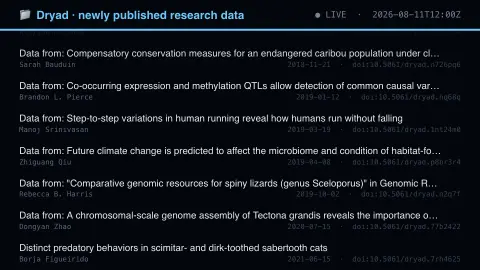
The The Spreadsheets Behind Papers screensaver shows research datasets newly published to Dryad, gathered by the pipeline because Dryad answers without a CORS header. Every entry carries a DOI, which is what makes data citable rather than merely available. It's free, runs in your browser, and ESC exits.
Live preview
Press ESC to leave fullscreen. Settings are saved in your browser only.
How the The Spreadsheets Behind Papers screensaver works
The saver reads the source described above and draws it on a canvas — no account, no tracking.
Research datasets newly published to Dryad, gathered by the pipeline because Dryad answers without a CORS header. Every entry carries a DOI, which is what makes data citable rather than merely available.
It refreshes on a schedule, so what you see stays current.
Colours and any options can be changed in settings; nothing is stored beyond your own browser.
About Dryad and published research data
Dryad is a not-for-profit membership organisation, recognised as a 501(c)(3) by the US Internal Revenue Service. It was originally built around ecology and evolutionary biology and now accepts data from all scientific disciplines. Researchers deposit the data and supporting files behind a paper, and Dryad partners with DataCite for persistent identifiers, so each published dataset gets a DOI. Dryad requires files to be compatible with the Creative Commons Zero waiver.
The DOI matters because it turns a dataset into something citable, like an article. Researchers can reference exactly the files they used, and a dataset’s author can receive credit when others reuse it. Journals were central to Dryad’s origins: a group of journals and societies introduced the Joint Data Archiving Policy in 2011, and Dryad integrates with manuscript systems and links datasets with articles in PubMed Central and Europe PMC.
Curators check that files can be opened, that metadata is complete and that nothing appears to carry sensitive data or copyright restrictions. Dryad is explicit that it does not attempt to assess rigor or veracity, so a record tells you data exist, not whether conclusions drawn from them are sound. Titles often echo the accompanying paper, so the feed can read like a list of article headlines.
A worked example
Research datasets newly published to Dryad, gathered by the pipeline because Dryad answers without a CORS header. Every entry carries a DOI, which is what makes data citable rather than merely available.
Settings & tips
- Accent and Background recolour the display.
- Every value on screen comes from the live source — nothing is simulated.
- Press ESC to leave fullscreen.
Frequently asked questions
- Is this real data?
- Yes — it comes from the source named on this page and is refreshed on a schedule.
- Is a key needed?
- No. This source is fully key-less.
- Is it free?
- Yes, and it runs entirely in your browser.
- Why does Dryad assign DOIs to datasets?
- A DOI gives each dataset a permanent, citable identifier so researchers can reference and reuse it with credit.
- Does Dryad review the science?
- No. Its curation checks that data are accessible and understandable, but it does not assess rigor or veracity. Scientific review belongs to the journal and the research community.
- What licence do the datasets use?
- Dryad requires files to be compatible with the Creative Commons Zero (CC0) waiver, which releases them to the public domain for reuse without restriction.