Released to the Archive Today Screensaver
The Released to the Archive Today screensaver shows studies released to EMBL-EBI BioStudies, key-less. Sorted on release_date rather than the field the docs suggest, which returns epoch values that parse to Invalid Date. It's free, runs in your browser, and ESC exits.
Live preview
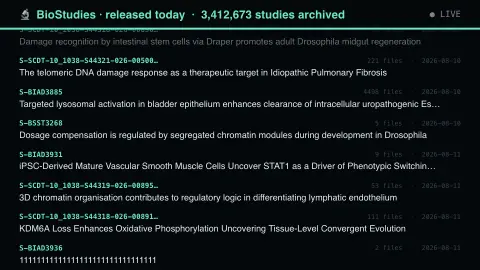
Press ESC to leave fullscreen. Settings are saved in your browser only.
How the Released to the Archive Today screensaver works
The saver reads the source described above and draws it on a canvas — no account, no tracking.
Studies released to EMBL-EBI BioStudies, key-less. Sorted on release_date rather than the field the docs suggest, which returns epoch values that parse to Invalid Date.
It refreshes on a schedule, so what you see stays current.
Colours and any options can be changed in settings; nothing is stored beyond your own browser.
What BioStudies archives
BioStudies is an EMBL-EBI database, run by Europe’s bioinformatics institute near Cambridge, that EMBL-EBI describes as one package for all the data supporting a study. It holds descriptions of biological studies, links to related data in other EMBL-EBI or external databases, and data that does not fit EMBL-EBI’s structured archives. Manuscript authors can also submit supplementary information and link to it from their publications.
It is organised into collections. Those listed on its home page include ArrayExpress, BioImages, BioImages-EMPIAR, Europe PMC and SourceData, so the stream can mix very different things, from supplementary files attached to papers to imaging collections. Its published description also says Europe PMC supplies data packages for papers with supplementary material.
The saver orders studies by release date, the day a record became public, which is different from when it was submitted. BioStudies lets depositors keep datasets private until the associated paper is published, so a cluster of releases can reflect publication timing rather than new experiments. The depositor retains control of their dataset, and a listing here does not show the files themselves or any quality assessment.
A worked example
Studies released to EMBL-EBI BioStudies, key-less. Sorted on release_date rather than the field the docs suggest, which returns epoch values that parse to Invalid Date.
Settings & tips
- Accent and Background recolour the display.
- Every value on screen comes from the live source — nothing is simulated.
- Press ESC to leave fullscreen.
Frequently asked questions
- Is this real data?
- Yes — it comes from the source named on this page and is refreshed on a schedule.
- Is a key needed?
- No. This source is fully key-less.
- Is it free?
- Yes, and it runs entirely in your browser.
- What is the difference between submission and release date?
- Submission is when authors deposit the study; release is when it becomes public. BioStudies lets authors keep a dataset private until the related paper is published.
- Does BioStudies replace specialist archives?
- No. It describes studies and holds data that does not fit EMBL-EBI’s structured archives, and it also links out to related data held in other databases.
- Are the records peer reviewed?
- BioStudies is a deposit archive in which the depositor keeps control of their dataset, so a listing is not a peer-review endorsement. Scientific review happens, if at all, with the journal that publishes the linked paper.