The Other Half Of Preprints Screensaver
The The Other Half Of Preprints screensaver shows newly posted preprints from the OSF servers, gathered key-less by the pipeline. It's free, runs in your browser, and ESC exits.
Live preview
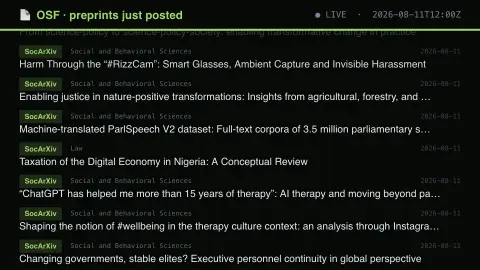
Press ESC to leave fullscreen. Settings are saved in your browser only.
How the The Other Half Of Preprints screensaver works
The saver reads the source described above and draws it on a canvas — no account, no tracking.
Newly posted preprints from the OSF servers, gathered key-less by the pipeline. arXiv, bioRxiv and medRxiv cover physics, biology and medicine; SocArXiv, PsyArXiv, EdArXiv and engrXiv carry everything else, posted in the open before any review.
It refreshes on a schedule, so what you see stays current.
Colours and any options can be changed in settings; nothing is stored beyond your own browser.
OSF and the community preprint servers
OSF, the Open Science Framework, is developed by the Center for Open Science, a non-profit. Besides its project-management tools it hosts OSF Preprints, a network of community-run preprint servers, among them SocArXiv for the social sciences, PsyArXiv for psychology, EdArXiv for education research, MediArXiv for media and communication studies and Law Archive for legal scholarship. They share one platform and one metadata format.
Each row in the feed carries a title, a subject area, the originating server, a date and a DOI. Authors can add the DOI, date and citation of the journal article to their preprint record, so a linked journal version is recorded alongside the preprint, which has its own DOI. Preprints cannot be deleted, only withdrawn, leaving the metadata behind.
This is the part of the preprint world that arXiv-style physics and biology feeds miss, and it skews toward fields where posting early is a newer habit. OSF's community servers use pre-moderation: a submission stays pending until a moderator accepts it, which checks that it belongs, not that the science is right. Preprints vary a good deal in maturity, from rough drafts to near-final manuscripts.
A worked example
Newly posted preprints from the OSF servers, gathered key-less by the pipeline. arXiv, bioRxiv and medRxiv cover physics, biology and medicine; SocArXiv, PsyArXiv, EdArXiv and engrXiv carry everything else, posted in the open before any review.
Settings & tips
- Accent and Background recolour the display.
- Every value on screen comes from the live source — nothing is simulated.
- Press ESC to leave fullscreen.
Frequently asked questions
- Is this real data?
- Yes — it comes from the source named on this page and is refreshed on a schedule.
- Is a key needed?
- No. This source is fully key-less.
- Is it free?
- Yes, and it runs entirely in your browser.
- Why does a preprint have a journal DOI?
- Authors can link a published article to their preprint record by adding its DOI, date and citation. The preprint itself keeps its own, separate DOI.
- Which servers are included?
- Community servers that run on OSF's preprint platform, such as SocArXiv, PsyArXiv and EdArXiv. The big independent servers like arXiv and bioRxiv are separate services.
- Are these papers vetted?
- On OSF's community servers a moderator accepts or rejects each submission before it appears, but this is a screening step, not peer review of the science. Treat each title as a manuscript offered for feedback.