What This Gene Does Screensaver
The What This Gene Does screensaver draws human genes one at a time with the curated plain-English summary that NCBI's annotators wrote for each: what the protein does, where it acts, and which disease appears when it fails. It runs in the browser with nothing to install; press ESC to exit.
Live preview
Press ESC to leave fullscreen. Settings are saved in your browser only.
How the What This Gene Does screensaver works
The saver reads MyGene.info, which serves NCBI gene annotation over a free API.
No account and no key: the request goes straight from your browser, or from this site's own refreshed copy of the feed where the source does not allow browser access.
Values are drawn on a canvas that resizes with the window, so it works on a laptop or a wall display.
If the source is unreachable the saver says so on screen rather than showing stale numbers as though they were current.
From a gene symbol to a plain summary
A gene is a stretch of DNA that carries instructions, most often for making a protein. Humans have on the order of twenty thousand protein-coding genes, each given a short official symbol by the HUGO Gene Nomenclature Committee (HGNC) and a numeric identifier in NCBI's Gene database. MyGene.info is a service that gathers annotation from public resources such as NCBI Entrez, Ensembl and UniProt and returns it through a simple web API.
The summary text shown for many genes comes from NCBI's RefSeq collection, where it appears in the record's comment as a short description of function. In reviewed RefSeq records the text is curated by NCBI staff. For less-studied genes the summary may be brief or absent, reflecting how much is currently known, not a lack of importance.
Gene symbols can mislead. They are often abbreviations from the lab that first found the gene, and some have been changed to avoid confusion: in 2020 HGNC renamed 27 symbols that spreadsheet software kept misreading as dates, so SEPT1 became SEPTIN1 and MARCH1 became MARCHF1. A summary describes normal function in general terms. It does not say what any particular genetic variant means for a person's health, and it is not medical information.
A worked example
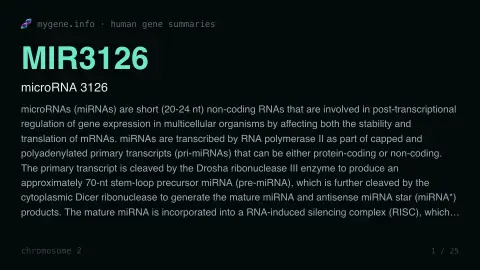
One gene fills the screen: the symbol large, the full name beneath it, then the curator's summary wrapped to the width, with the chromosome in the corner. It cycles every eleven seconds or so. The query restricts to humans — taxid 9606 — because the same symbol exists in mouse, zebrafish and fruit fly, and cycling through four species' versions of the same gene is merely confusing.
Settings & tips
- Accent and Background recolour the display without changing the data.
- Add it to a Multi-view grid to watch it alongside other live savers.
- Press ESC at any time to leave fullscreen.
Frequently asked questions
- Who writes these summaries?
- Curators at NCBI's RefSeq project, working from the published literature. They are written for scientists but are unusually readable, which is why they work on screen.
- Why only human genes?
- Because the same gene symbol is reused across species. Without the taxid filter the saver would show the human, mouse and zebrafish versions of one gene in sequence as though they were three different things.
- Is this real data?
- Yes. It comes from MyGene.info, which serves NCBI gene annotation over a free API. Nothing is invented or simulated, and if the source cannot be reached the saver reports that instead of drawing something plausible.
- Does it cost anything or need an account?
- No. Every screensaver here is free, runs in the browser and needs no sign-up. This one uses a public API that requires no key.
- What does a gene symbol stand for?
- Often an abbreviation of its name or function, such as a protein it encodes, but not always. Official symbols are standardised by HGNC, though older nicknames from original discoverers persist.
- Do all genes make proteins?
- No. Many genes produce functional RNA molecules instead, and large regions of the genome help control when and where other genes are switched on.
- Does a short summary mean the gene is unimportant?
- No. It more likely means the gene has been studied less so far, and summaries tend to grow as research accumulates.