Global Vaccination Coverage Board Screensaver
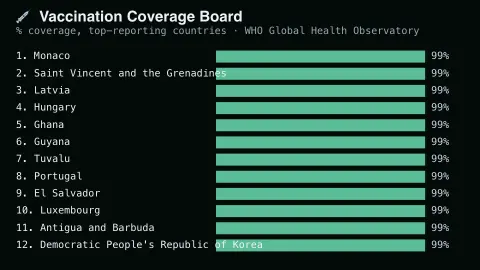
The Global Vaccination Coverage Board screensaver ranks countries by real childhood vaccination coverage, from the World Health Organization's own published data. It is free, runs in your browser, and ESC exits.
Live preview
Press ESC to leave fullscreen. Settings are saved in your browser only.
How the Global Vaccination Coverage Board screensaver works
The saver reads real published childhood immunization coverage figures from the World Health Organization's Global Health Observatory.
Countries are ranked by their real reported coverage percentage.
The pipeline refreshes the data on the source's own real reporting schedule.
No key is required for the published WHO data.
Where immunisation coverage figures come from
Coverage figures here come from the WHO and UNICEF Estimates of National Immunization Coverage (WUENIC), which are produced every year and released in mid-July. Each country's number is the percentage of its target children who received a given vaccine dose, and the series is built by reviewing administrative records reported by countries alongside household survey results.
The two sources can disagree. Administrative counts depend on accurate counting of vaccinated children and on a reliable target population, which in turn depends on recent censuses and birth registration. Surveys usually target children aged 12 to 23 or 24 to 35 months and confirm vaccination from cards or caregiver recall, and they can miss hard-to-reach groups. WHO and UNICEF review each country's data individually, so a country's estimate can be revised from one release to the next.
A national percentage averages over every district, so it can hide pockets where uptake is far lower, and it says nothing about timeliness or the whole childhood schedule. Where many countries sit near the top, ties are common and small differences between them are not meaningful. This is a statistical summary, not medical advice.
A worked example
A country with real reported coverage above 95% appears near the top of the ranked board, exactly matching the WHO's own published figure.
Settings & tips
- Accent recolours the ranking bars.
- Figures are real WHO-reported national averages.
- Coverage figures are updated on WHO's own real annual reporting cycle.
Frequently asked questions
- Is this real health data?
- Yes — real published figures from the WHO Global Health Observatory.
- Is a key needed?
- No. WHO publishes this data freely.
- Which vaccine is tracked?
- A widely reported childhood immunization indicator used across WHO member states.
- Is it free?
- Yes — free, no download, in your browser.
- Why do so many countries show the same figure?
- Estimates are reported as whole percentages and many countries sit near the top, so ties are common. Small differences among them are not informative.
- Can coverage be high nationally and low locally?
- Yes. A national percentage averages over every district, so local gaps can exist even where the country-wide figure is very high.