Children Per Woman Screensaver
The Children Per Woman screensaver ranks countries by total fertility rate — the number of children a woman would have over her lifetime at current age-specific rates — from the Demographic and Health Surveys programme. Replacement level is about 2.1. It runs in the browser with nothing to install; press ESC to exit.
Live preview
Press ESC to leave fullscreen. Settings are saved in your browser only.
How the Children Per Woman screensaver works
The saver reads The DHS Program API, which publishes nationally representative survey results.
No account and no key: the request goes straight from your browser, or from this site's own refreshed copy of the feed where the source does not allow browser access.
Values are drawn on a canvas that resizes with the window, so it works on a laptop or a wall display.
If the source is unreachable the saver says so on screen rather than showing stale numbers as though they were current.
Counting births through household surveys
The Demographic and Health Surveys (DHS) Program was established by the United States Agency for International Development in 1984 and runs large household surveys in low- and middle-income countries, working with national partners. Where civil registration is incomplete, such surveys are one of the main sources of fertility figures. Women of reproductive age, 15 to 49, are interviewed about their birth histories, and analysts then compute rates by age group.
Total fertility rate is a synthetic measure. The DHS Program publishes it for the three years preceding the survey, adding up the age-specific birth rates in that window to give the number of children a woman would have if she experienced those rates all her life. It is not a count of children any real cohort ended up with, and it can swing when births are delayed or brought forward.
The ranking only covers countries with a survey in the programme’s database, and each survey was taken in a particular year. Two countries listed side by side may have been measured many years apart, and surveys are sample-based, so every figure carries a margin of error. A country may therefore have changed considerably since its latest survey.
A worked example
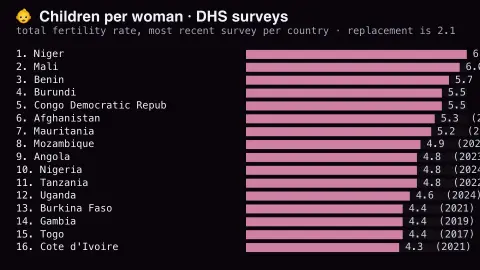
Sixteen countries ranked highest first, each with its rate to one decimal place and, in brackets, the year of the survey it came from. The year is not decoration: these are survey estimates with a field date, not a live counter, and a country surveyed in 2015 has almost certainly moved since. Where a country has several rounds, only the most recent is kept.
Settings & tips
- Accent and Background recolour the display without changing the data.
- Add it to a Multi-view grid to watch it alongside other live savers.
- Press ESC at any time to leave fullscreen.
Frequently asked questions
- What is total fertility rate?
- The number of children a woman would bear if she lived through her childbearing years experiencing the age-specific birth rates currently observed. It is a synthetic measure of the present moment, not a prediction about any real cohort.
- Why are these countries mostly African and South Asian?
- Because that is where DHS runs its surveys. The programme focuses on low and middle income countries, so this is not a world ranking — wealthy countries with low fertility are simply not in the dataset.
- Is this real data?
- Yes. It comes from The DHS Program API, which publishes nationally representative survey results. Nothing is invented or simulated, and if the source cannot be reached the saver reports that instead of drawing something plausible.
- Does it cost anything or need an account?
- No. Every screensaver here is free, runs in the browser and needs no sign-up. This one uses a public API that requires no key.
- Why are survey years different for different countries?
- Each country is surveyed on its own timetable, so the latest available figures can come from different years.
- Is total fertility rate the same as the number of children per family?
- No. It is a period measure built from age-specific rates in a recent window, whereas completed family size is only known once a generation has finished having children.
- Do the surveys cover rich countries?
- Generally not. The programme focuses on low- and middle-income countries, so high-income nations are mostly absent from this list.