The Vocabulary Of What Genes Do Screensaver
The The Vocabulary Of What Genes Do screensaver shows gene Ontology terms, key-less from EMBL-EBI's QuickGO. GO is how biology agreed to describe function without arguing about words, and the three-way split is the whole design: a biological process, a molecular function, or a cellular component — what it does, how, and where. The definition arrives as an object with the text nested inside rather than as a string. It's free, runs in your browser, and ESC exits.
Live preview
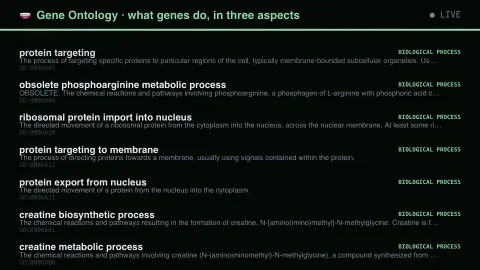
Press ESC to leave fullscreen. Settings are saved in your browser only.
How the The Vocabulary Of What Genes Do screensaver works
The saver reads the source described above and draws it on a canvas — no account, no tracking.
Gene Ontology terms, key-less from EMBL-EBI's QuickGO. GO is how biology agreed to describe function without arguing about words, and the three-way split is the whole design: a biological process, a molecular function, or a cellular component — what it does, how, and where. The definition arrives as an object with the text nested inside rather than as a string.
It refreshes on a schedule, so what you see stays current.
Colours can be changed in settings; nothing is stored beyond your own browser.
What the Gene Ontology is for
The Gene Ontology, or GO, is a controlled vocabulary used to describe what gene products do, maintained by the Gene Ontology Consortium. It exists so that a gene studied in a mouse, a yeast cell or a human can be described in the same terms, which lets researchers compare results across species. QuickGO is EMBL-EBI’s web browser for GO terms and for the annotations that link them to gene products, run by the GOA group.
The terms form a graph, not a flat list. Each term has a unique identifier made of GO: followed by seven digits, a name, a definition and relationships to other terms. Almost every term has an is_a link to a more general parent, and a term can have more than one parent. Other relations, such as part_of, link terms in different ways.
The three aspects separate different questions. Molecular function describes activities performed by gene products, cellular component describes where a function takes place, and biological process describes larger programmes carried out by several molecular activities. The ontology is revised as knowledge grows: an obsolete term keeps its ID but is tagged as obsolete. A term on the board describes a concept in the vocabulary, not a particular gene.
A worked example
Gene Ontology terms, key-less from EMBL-EBI's QuickGO. GO is how biology agreed to describe function without arguing about words, and the three-way split is the whole design: a biological process, a molecular function, or a cellular component — what it does, how, and where. The definition arrives as an object with the text nested inside rather than as a string.
Settings & tips
- Accent and Background recolour the display.
- Every value on screen comes from the live source — nothing is simulated.
- Press ESC to leave fullscreen.
Frequently asked questions
- Is this real data?
- Yes — it comes from the source named on this page and is refreshed on a schedule.
- Is a key needed?
- No. This source is fully key-less.
- Is it free?
- Yes, and it runs entirely in your browser.
- What does a GO identifier look like?
- It is GO: followed by seven digits, for example GO:0005739, and it stays attached to the concept even if the wording around it is revised.
- Can a term become obsolete?
- Yes. A term can be obsoleted if it is out of scope, misleading or better represented another way. It keeps its ID, is tagged as obsolete, and a comment usually explains why and suggests replacements.
- Is a GO term the same as a gene?
- No. A term is a concept in the vocabulary, while genes or proteins are linked to terms through separate annotations.