The Vocabularies Biology Runs On Screensaver
The The Vocabularies Biology Runs On screensaver shows every ontology in EMBL-EBI's Ontology Lookup Service, ranked by terms defined and key-less. An ontology is how two databases agree that "heart attack" and "myocardial infarction" are the same thing. It's free, runs in your browser, and ESC exits.
Live preview
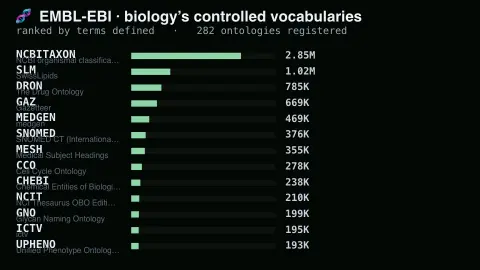
Press ESC to leave fullscreen. Settings are saved in your browser only.
How the The Vocabularies Biology Runs On screensaver works
The saver reads the source described above and draws it on a canvas — no account, no tracking.
Every ontology in EMBL-EBI's Ontology Lookup Service, ranked by terms defined and key-less. An ontology is how two databases agree that "heart attack" and "myocardial infarction" are the same thing.
It refreshes on a schedule, so what you see stays current.
Colours and any options can be changed in settings; nothing is stored beyond your own browser.
What an ontology is, and what OLS holds
In the life sciences an ontology is a controlled vocabulary with structure: each concept has an identifier and a label, and is linked to other concepts by relationships such as is a and part of. Because every term has a stable ID, two databases can agree that different wordings mean the same thing, and software can reason that a disease of the left ventricle is a kind of heart disease.
EMBL-EBI's Ontology Lookup Service, OLS, is a repository and browser for biomedical ontologies, aiming to give a single point of access to their latest versions through a website and an API. It was first released in 2006, and the current version, OLS4, replaced OLS3 in production at EMBL-EBI, adds full OWL2 support and keeps a backward-compatible API. Its source code is open on GitHub under the Apache 2.0 licence.
Ranking by term count measures breadth, not importance. A huge ontology will outrank a small but heavily used one, and some ontologies include terms imported from others, so counts can overlap. Term counts also change as maintainers release new versions that add, obsolete and merge terms, which is why the ranking can move even when nothing dramatic has happened.
A worked example
Every ontology in EMBL-EBI's Ontology Lookup Service, ranked by terms defined and key-less. An ontology is how two databases agree that "heart attack" and "myocardial infarction" are the same thing.
Settings & tips
- Accent and Background recolour the display.
- Every value on screen comes from the live source — nothing is simulated.
- Press ESC to leave fullscreen.
Frequently asked questions
- Is this real data?
- Yes — it comes from the source named on this page and is refreshed on a schedule.
- Is a key needed?
- No. This source is fully key-less.
- Is it free?
- Yes, and it runs entirely in your browser.
- What is a term in an ontology?
- A term is a single concept with a unique identifier and a label, linked to related concepts by relationships such as is a and part of.
- Does a bigger ontology mean a better one?
- No. Size shows how many terms are defined, not how accurate or widely adopted the vocabulary is.
- What is OLS4?
- It is the current version of EMBL-EBI's Ontology Lookup Service. It replaced OLS3 in production, supports full OWL2 and keeps a backward-compatible API.