All Known Life, To Scale Screensaver
The All Known Life, To Scale screensaver shows the Catalogue of Life tree drawn proportionally, read live and key-less from ChecklistBank. It's free, runs in your browser, and ESC exits.
Live preview
Press ESC to leave fullscreen. Settings are saved in your browser only.
How the All Known Life, To Scale screensaver works
The saver reads the source described above and draws it on a canvas — no account, no tracking.
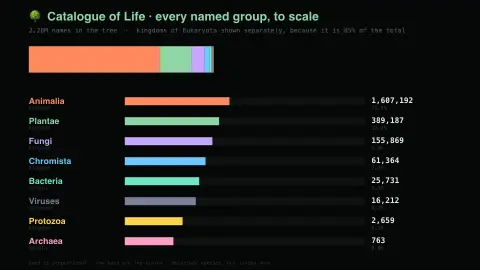
The Catalogue of Life tree drawn proportionally, read live and key-less from ChecklistBank. Beetles and their neighbours make animals enormous, and bacteria barely register — because naming a bacterium is hard, not because there are few of them.
It refreshes on a schedule, so what you see stays current.
Colours and any options can be changed in settings; nothing is stored beyond your own browser.
The Catalogue of Life, drawn to scale
The Catalogue of Life is a global checklist of species, assembled from many specialist taxonomic databases, each maintained by experts on a particular group. Editors choose which contributed sector to use for each part of the tree and integrate them into a single classification. Even so, the project has always described itself as incomplete, since it covers only species that have been formally recognised.
ChecklistBank, the service this saver reads, is the infrastructure behind the Catalogue of Life, co-developed with GBIF. It hosts the data sources that feed the Catalogue as well as many other checklists, such as national and regional lists, and lets software search and download them through an API. That is how a program can walk the hierarchy from kingdom down to species.
The key word is described. The figures reflect species that scientists have formally named and recorded, not species that exist. Beetles look enormous because so many have been named, while microbes barely register because formally naming a bacterium is hard, not because there are few of them. The checklist also changes as taxonomists merge, split and rename groups, so the tree is a working snapshot of knowledge rather than a final inventory.
A worked example
The Catalogue of Life tree drawn proportionally, read live and key-less from ChecklistBank. Beetles and their neighbours make animals enormous, and bacteria barely register — because naming a bacterium is hard, not because there are few of them.
Settings & tips
- Accent and Background recolour the display.
- Every value on screen comes from the live source — nothing is simulated.
- Press ESC to leave fullscreen.
Frequently asked questions
- Is this real data?
- Yes — it comes from the source named on this page and is refreshed on a schedule.
- Is a key needed?
- No. This source is fully key-less.
- Is it free?
- Yes, and it runs entirely in your browser.
- Does the size of a branch mean how many individuals exist?
- No. It reflects named species, not individual organisms or population sizes. A branch can be large simply because many taxonomists have studied it.
- What is ChecklistBank?
- It is the platform behind the Catalogue of Life, co-developed with GBIF. It publishes and stores taxonomic checklists and makes them searchable, downloadable and available through an API.
- Why can groups change between visits?
- Taxonomy is revised constantly: species are synonymised, split or moved, and the checklist is updated as those decisions are made.