GBIF Species Occurrence Feed Screensaver
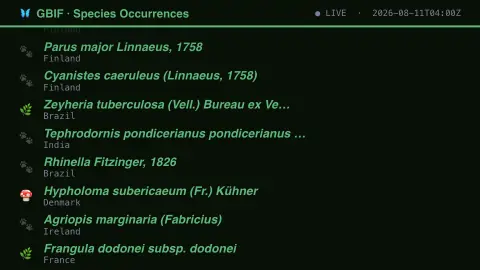
The GBIF Species Occurrence Feed screensaver streams real species occurrence records aggregated from museums and citizen science worldwide. It is free, runs in your browser, and ESC exits.
Live preview
Press ESC to leave fullscreen. Settings are saved in your browser only.
How the GBIF Species Occurrence Feed screensaver works
The saver reads real recent occurrence records from GBIF's own public API, sorted by event date.
Each entry shows a real scientific name, kingdom and reporting country.
The pipeline refreshes the feed regularly as new records are indexed.
No key is required for this key-less public endpoint.
GBIF and the biodiversity data it brings together
The Global Biodiversity Information Facility is an international research infrastructure, funded by governments, that makes data about the occurrence of life on Earth openly available. It does not collect specimens itself. Instead it aggregates records from publishing organisations around the world: natural history museums, herbaria, research projects, monitoring schemes and citizen science platforms. A single record, called an occurrence, states that a given organism was observed or collected at a place and time.
Each entry shows a scientific name, a kingdom (animals, plants, fungi and so on) and the country where it was recorded. GBIF’s basis of record field says what kind of evidence stands behind an occurrence, such as a human observation, a preserved specimen in a collection, a machine observation like a photograph or audio recording, or a fossil specimen. A museum specimen could have been collected a century ago, so the event date gives when the organism was recorded, not when the record was entered.
Records are only as good as their source. Names are matched to a reference taxonomy that reconciles competing classifications, and GBIF’s own guidance warns that publishers do not always fill in fields such as basis of record correctly, so data should be checked before use. Coverage is also uneven, because records depend on where observers and institutions are active.
A worked example
A real occurrence record for a real species observed in a real country scrolls past exactly as reported to GBIF's aggregated index.
Settings & tips
- Records blend real museum specimens with real citizen-science sightings.
- Accent recolours the ticker text.
- GBIF aggregates data from thousands of real institutional providers.
Frequently asked questions
- Is this real biodiversity data?
- Yes — real occurrence records from GBIF's aggregated index.
- Is a key needed?
- No. GBIF's occurrence search API is fully key-less.
- Is this the same as iNaturalist?
- GBIF aggregates iNaturalist and many other real sources, including museum specimens.
- Is it free?
- Yes — free, no download, in your browser.
- What is an occurrence record?
- A statement that a particular organism was observed or collected at a specific place and time, whether by a person, an instrument or from a museum specimen.
- What does the basis of record mean?
- It says what kind of evidence the record rests on, such as a human observation, a preserved specimen, a machine observation or a fossil specimen.
- Why is coverage so uneven?
- Records depend on where observers and institutions are active, so well-studied regions and popular groups tend to have more data than remote areas and obscure organisms.