Full Disclosure Screensaver
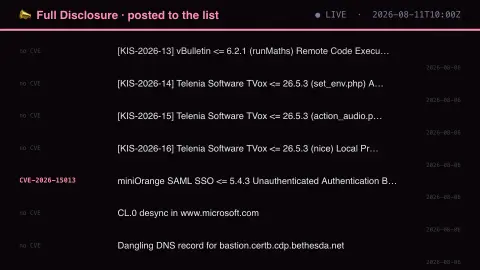
The Full Disclosure screensaver shows findings posted to the Full Disclosure mailing list, key-less. It’s free, runs in your browser, and ESC exits.
Live preview
Press ESC to leave fullscreen. Settings are saved in your browser only.
How the Full Disclosure screensaver works
The saver reads the source described above and draws it on a canvas — no account, no tracking.
Findings posted to the Full Disclosure mailing list, key-less. The old tradition: publish whether or not the vendor is ready. Some posts carry a CVE and read like advisories; plenty are simply someone showing their working.
It refreshes on a schedule, so what you see stays current.
Colours and any options can be changed in settings; nothing is stored beyond your own browser.
The Full Disclosure tradition
Full Disclosure is a lightly moderated security mailing list where researchers post details of vulnerabilities, exploit code and commentary. It was created in 2002 by Len Rose. In March 2014 its then operator, John Cartwright, shut the original list down after a researcher demanded large-scale deletions and threatened legal action, and Fyodor, the creator of Nmap, relaunched it on 25 March 2014. It is now part of the public seclists.org archive.
The name comes from a long-running argument about how flaws should be revealed. On one side are advocates of coordinated disclosure, who tell the vendor privately first and publish after a fix or a deadline. On the other are those who favour full, public disclosure of everything at once. Posts often come without a vendor patch, and some carry a CVE number while others do not.
Quality varies: a post can be a careful write-up with a proof of concept, a bulletin copied from a vendor, or just someone showing their working. The list is lightly moderated rather than curated, so titles are the poster's own. Items describe flaws and are not instructions for you to follow; the dates are when messages were posted.
A worked example
Findings posted to the Full Disclosure mailing list, key-less. The old tradition: publish whether or not the vendor is ready. Some posts carry a CVE and read like advisories; plenty are simply someone showing their working.
Settings & tips
- Accent and Background recolour the display.
- Every value on screen comes from the live source — nothing is simulated.
- Press ESC to leave fullscreen.
Frequently asked questions
- Is this real data?
- Yes — it comes from the source named on this page and is refreshed on a schedule.
- Is a key needed?
- No. This source is fully key-less.
- Is it free?
- Yes, and it runs entirely in your browser.
- Is everything posted here confirmed?
- No. Posts are the authors' own claims, and the list does not verify them.
- What is coordinated disclosure?
- A practice where researchers notify the vendor first and publish only after a fix is ready or a deadline passes.
- Why do some posts have no CVE?
- A CVE ID is not required to post, and many posts are published before, or without, one being assigned.