Exploit Archive Screensaver
The Exploit Archive screensaver shows the Exploit-DB archive of working exploit code, key-less. It’s free, runs in your browser, and ESC exits.
Live preview
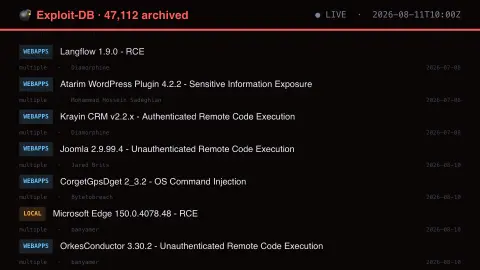
Press ESC to leave fullscreen. Settings are saved in your browser only.
How the Exploit Archive screensaver works
The saver reads the source described above and draws it on a canvas — no account, no tracking.
The Exploit-DB archive of working exploit code, key-less. Nearly fifty thousand entries, and the shape is the story: web application bugs outnumber the rest several times over. "Verified" means someone reproduced it, and most entries are not.
It refreshes on a schedule, so what you see stays current.
Colours and any options can be changed in settings; nothing is stored beyond your own browser.
What the Exploit Database is
The Exploit Database is a public archive of exploits and proof-of-concept code together with the vulnerable software they target, run by the security training company OffSec as a public service. It is built for penetration testers and vulnerability researchers, and it is described as CVE compliant. Its focus is exploit code and proof-of-concepts rather than advisories. A command-line tool, SearchSploit, lets people search a local copy offline, which helps on isolated networks.
Entries are classified by type: webapps for web application bugs, remote and local for attacks run over a network versus ones needing access to the machine, dos for denial-of-service crashes, plus shellcode, papers and hardware. Entries can also be filtered by platform, tags such as SQL injection and cross-site scripting, port and author. The same site hosts the Google Hacking Database of search queries that find exposed information.
An entry’s presence does not mean the flaw is being used in attacks, nor that the code works against current versions. The site offers a Verified filter, and in the saver’s data verification is the exception rather than the rule. The source file is sorted by internal ID, so the saver re-sorts it by date added.
A worked example
The Exploit-DB archive of working exploit code, key-less. Nearly fifty thousand entries, and the shape is the story: web application bugs outnumber the rest several times over. "Verified" means someone reproduced it, and most entries are not.
Settings & tips
- Accent and Background recolour the display.
- Every value on screen comes from the live source — nothing is simulated.
- Press ESC to leave fullscreen.
Frequently asked questions
- Is this real data?
- Yes — it comes from the source named on this page and is refreshed on a schedule.
- Is a key needed?
- No. This source is fully key-less.
- Is it free?
- Yes, and it runs entirely in your browser.
- What does verified mean?
- Exploit-DB offers a Verified filter in its search, and verified entries are the ones the project has marked as such. Treat an unverified entry as unconfirmed rather than as proof the exploit works.
- Are these exploits used in real attacks?
- Some may be, but the archive is a reference for researchers and testers. Appearing here says nothing about whether any attacker has used the code.
- What do the type labels mean?
- They group entries by kind: webapps for web application flaws, remote and local for network-based versus on-machine attacks, dos for denial of service, and shellcode, papers and hardware for the rest.