Push-Button Exploits Screensaver
The Push-Button Exploits screensaver shows metasploit module metadata straight from the framework, key-less. It’s free, runs in your browser, and ESC exits.
Live preview
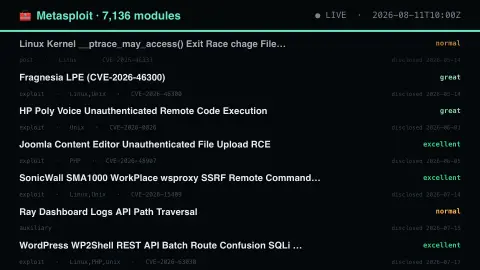
Press ESC to leave fullscreen. Settings are saved in your browser only.
How the Push-Button Exploits screensaver works
The saver reads the source described above and draws it on a canvas — no account, no tracking.
Metasploit module metadata straight from the framework, key-less. Rank is the project’s own promise about reliability — excellent means it will not crash the target — so a high rank on an old CVE means that bug is now trivial to use.
It refreshes on a schedule, so what you see stays current.
Colours and any options can be changed in settings; nothing is stored beyond your own browser.
What Metasploit rank means
The Metasploit Framework is an open-source tool for security testing. H. D. Moore created it in 2003, and Rapid7 acquired the project in October 2009. It is a library of modules that penetration testers and defenders use to check whether a system is vulnerable under authorised conditions. Module types include exploits, payloads and auxiliary modules, a group that covers scanners, admin and server modules.
Each exploit has a rank that describes how reliably and safely it behaves. From least to most reliable the ladder is Manual, Low, Average, Normal, Good, Great and Excellent. The framework stores these as numbers from 0 for Manual up to 600 for Excellent, in steps of 100, so Normal is 300. Excellent means the exploit will never crash the service, as with SQL injection or command execution flaws. Manual marks modules that are unstable or difficult to exploit, or that need user configuration to be useful.
A rank describes the module's reliability and predictability, not how serious the underlying vulnerability is. A module existing in the framework means a public exploit module exists for that flaw, which defenders often take as a reason to prioritise patching. It does not show that anyone has attacked a given organisation.
A worked example
Metasploit module metadata straight from the framework, key-less. Rank is the project’s own promise about reliability — excellent means it will not crash the target — so a high rank on an old CVE means that bug is now trivial to use.
Settings & tips
- Accent and Background recolour the display.
- Every value on screen comes from the live source — nothing is simulated.
- Press ESC to leave fullscreen.
Frequently asked questions
- Is this real data?
- Yes — it comes from the source named on this page and is refreshed on a schedule.
- Is a key needed?
- No. This source is fully key-less.
- Is it free?
- Yes, and it runs entirely in your browser.
- Is a higher rank a more dangerous vulnerability?
- No. Rank is about the module's reliability, such as whether it avoids crashing the target, and not about the impact of the flaw itself.
- What does the rank number mean?
- The framework maps each rank to a number: Manual 0, Low 100, Average 200, Normal 300, Good 400, Great 500 and Excellent 600. A higher number means a more reliable exploit.
- What kinds of module are there?
- Exploits, payloads and auxiliary modules are the main groups. Auxiliary modules cover tasks such as scanning, fuzzing and sniffing.