France, By Commune Screensaver
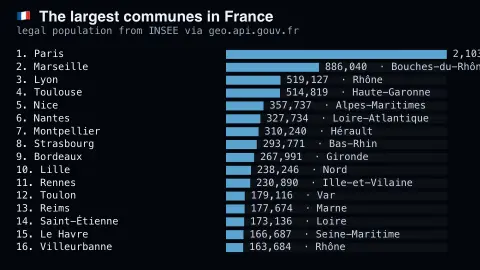
The France, By Commune screensaver ranks the largest French communes by legal population, from the official geography API maintained by the French state. France has more communes than the rest of the European Union combined, most of them villages of a few hundred people. It runs in the browser with nothing to install; press ESC to exit.
Live preview
Press ESC to leave fullscreen. Settings are saved in your browser only.
How the France, By Commune screensaver works
The saver reads geo.api.gouv.fr, the French government's official geography API, sourced from INSEE.
No account and no key: the request goes straight from your browser, or from this site's own refreshed copy of the feed where the source does not allow browser access.
Values are drawn on a canvas that resizes with the window, so it works on a laptop or a wall display.
If the source is unreachable the saver says so on screen rather than showing stale numbers as though they were current.
The commune, France's smallest unit of government
The commune is the basic local authority in France. The communes were created during the Revolution, in 1789–1790, mostly out of the old parishes, and the country still has roughly 34,000 of them, far more than any other European country. Many are tiny villages, while a few are great cities. The data in this saver comes from geo.api.gouv.fr, the French government’s geography API, which exposes each commune’s name, codes, department, region and population.
The population attached to a commune comes from INSEE, the national statistics institute, which publishes official figures each year in December that take effect on 1 January of the following year. Each figure refers to an earlier reference year, the middle of a five-year cycle of census surveys, so the January 2023 figures describe 1 January 2020. It is not a live count. A department is the next level up, grouping communes under a prefecture.
Commune boundaries often follow historical limits rather than the built-up area of a city, so the commune of a major city can be far smaller than its urban area. Paris is the most populous commune, yet its urban area extends across nearly 400 communes. Since 2019 Paris has also held the powers of both a commune and a department. Communes merge from time to time, notably as communes nouvelles, which changes codes and counts.
A worked example
Sixteen communes ranked by population, each with its département alongside. The tail is so long that the top of the list looks unrepresentative: Paris is over two million, and by the twentieth entry you are already under 150,000. The populations are INSEE's legal populations, the figures used for administrative purposes.
Settings & tips
- Accent and Background recolour the display without changing the data.
- Add it to a Multi-view grid to watch it alongside other live savers.
- Press ESC at any time to leave fullscreen.
Frequently asked questions
- What is a commune?
- France's smallest administrative division — the level that has a mayor and a council. There are around 34,000 of them, ranging from Paris to hamlets with a dozen residents.
- What is a legal population?
- The official figure INSEE publishes for administrative use, updated on a rolling census cycle. It is what determines a commune's entitlements and obligations, so it is the number that legally counts.
- Is this real data?
- Yes. It comes from geo.api.gouv.fr, the French government's official geography API, sourced from INSEE. Nothing is invented or simulated, and if the source cannot be reached the saver reports that instead of drawing something plausible.
- Does it cost anything or need an account?
- No. Every screensaver here is free, runs in the browser and needs no sign-up. This one uses a public API that requires no key.
- Why are there so many communes in France?
- The Revolution turned most of the roughly 60,000 parishes into communes in 1789–1790, and many small villages have kept their own councils instead of merging. Merger incentives have only partly reduced the number.
- How is legal population different from the real population?
- INSEE’s official figure refers to a reference year in the middle of a five-year cycle of census surveys, so it describes the situation about three years before it takes effect. Actual residents change continually.
- Does the city figure include its suburbs?
- Usually not. The figure covers only the commune proper, while surrounding urban areas are made up of other communes with their own entries. Paris’s urban area, for example, spans nearly 400 communes.