Forecast Confidence Screensaver
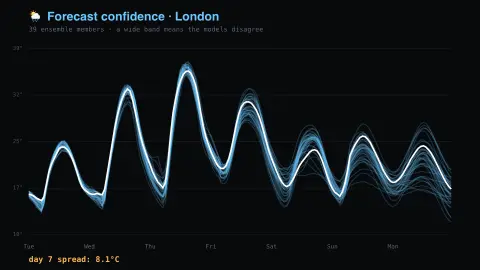
The Forecast Confidence screensaver shows every member of a weather ensemble drawn at once. Where the members agree the band is tight and the forecast is trustworthy; where they fan apart, nobody actually knows yet. It's free, runs in your browser, and ESC exits.
Live preview
Press ESC to leave fullscreen. Settings are saved in your browser only.
How the Forecast Confidence screensaver works
The saver reads Open-Meteo's ensemble API directly in your browser — no key and no account.
Every member of a weather ensemble drawn at once.
It refreshes on a schedule, so what you see stays current.
Colours can be changed in settings; nothing is stored beyond your own browser.
Why forecasters run many versions of the weather
Weather is a chaotic system: a tiny error in the starting measurements grows as a forecast moves forward, so no single run can be certain. Ensemble forecasting deals with this by running the same model many times, each from slightly perturbed starting conditions, and often with small variations in how uncertain model parameters are treated. The set of runs is called an ensemble and each run a member.
The underlying insight is usually credited to Edward Lorenz, whose 1963 work showed that the equations of the atmosphere are chaotic, which limits useful forecasts to roughly two weeks. Operational centres run ensembles routinely: Open-Meteo’s ensemble API, for example, offers models from ECMWF with 51 members, NOAA’s GFS ensemble with 31, and others from Germany, Canada, Australia and the UK.
Reading the display is mostly about spread. When the lines sit close together, the members agree and the forecast has high confidence. When they fan out, small differences have grown and the outcome is genuinely uncertain. In verification studies the ensemble mean typically scores better than any single member, but an ensemble does not say which line will turn out right.
A worked example
Every member of a weather ensemble drawn at once. Where the members agree the band is tight and the forecast is trustworthy; where they fan apart, nobody actually knows yet.
Settings & tips
- Accent and Background recolour the display.
- Data comes straight from Open-Meteo's ensemble API in your browser.
- Press ESC to leave fullscreen.
Frequently asked questions
- Is this real data?
- Yes — it comes from Open-Meteo's ensemble API and is refreshed on a schedule.
- Why are there so many lines?
- Each is one member of the ensemble — the same model run from slightly different starting conditions. Where they agree the forecast is solid; where they fan apart it genuinely isn't known.
- Is a key needed?
- No. This source is fully key-less.
- Is it free?
- Yes — free, no download, in your browser.
- Does the middle of the lines give the real forecast?
- The ensemble mean typically gives a better forecast than any single member, but it is not guaranteed to be the best estimate. A wide fan means no single outcome should be treated as likely.
- Why does the spread usually widen further into the future?
- Small initial errors grow over time in a chaotic system, so members that began almost identical gradually diverge. Short-range forecasts therefore tend to be tighter than long-range ones.
- Can the members all agree and still be wrong?
- Yes. Agreement shows the model is consistent, but if the model has a shared flaw or misses a process, every member can share the same error.