Folding@home Projects Screensaver
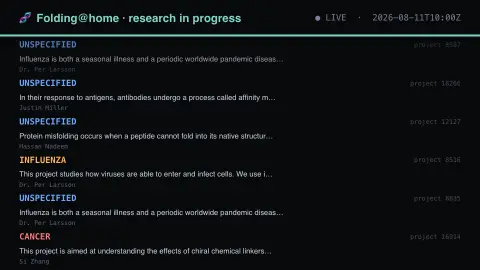
The Folding@home Projects screensaver shows the research actually being computed right now on volunteers' machines, gathered key-less by the pipeline: which disease each project targets and who is running it. It's free, runs in your browser, and ESC exits.
Live preview
Press ESC to leave fullscreen. Settings are saved in your browser only.
How the Folding@home Projects screensaver works
The background pipeline reads this from Folding@home and saves a snapshot the saver loads.
The research actually being computed right now on volunteers' machines, gathered key-less by the pipeline: which disease each project targets and who is running it..
It refreshes on a schedule, so what you see stays current.
Colours can be changed in settings; nothing is stored beyond your own browser.
How Folding@home works
Folding@home is a distributed computing project that uses volunteers’ spare processor and graphics-card time to simulate how proteins move. It launched in October 2000 out of Vijay Pande’s group, and today it is led by Greg Bowman at the University of Pennsylvania, with a consortium of research labs proposing and analysing the simulations. Proteins fold into precise three-dimensional shapes, and mistakes in that process or in how they bind molecules matter in many diseases.
Work is divided into projects, each identified by a number and run by a named researcher. A project is a set of molecular-dynamics simulations of a particular target, and the feed gives its research area, such as COVID-19, its manager and a short description. The COVID-19 program that began in March 2020 started with projects simulating potentially druggable proteins of SARS-CoV-2 and the related SARS-CoV.
Being listed means a project is distributing work to volunteer computers, not that it has produced results. Simulations generate data that researchers analyse over months, and publication follows long after the computing. The total in the feed counts projects, not people, and volunteer numbers vary with the projects on offer.
A worked example
The research actually being computed right now on volunteers' machines, gathered key-less by the pipeline: which disease each project targets and who is running it.
Settings & tips
- Accent and Background recolour the display.
- Run
automation/run.py foldingto refresh the feed. - Press ESC to leave fullscreen.
Frequently asked questions
- Is this real data?
- Yes — it comes from Folding@home and is refreshed on a schedule.
- Is a key needed?
- No. This source is fully key-less.
- Is it free?
- Yes — free, no download, in your browser.
- Does running a project here help with my own computer?
- No. This screensaver only displays which projects exist. Donating computing time requires installing the Folding@home client separately.
- What is molecular dynamics?
- It is a method that simulates how the atoms in a molecule move over tiny time steps, which lets researchers watch folding and binding that experiments cannot easily follow.