Exchange Hack Ledger Screensaver
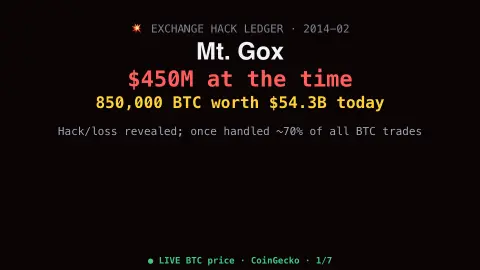
The Exchange Hack Ledger screensaver scrolls through a real historical record of major crypto exchange hacks and collapses — Mt. Gox, FTX and more — with real dollar figures at the time, plus a live tally of what the lost bitcoin would be worth today. It's free, runs in your browser, and ESC exits.
Live preview
Press ESC to leave fullscreen. Settings are saved in your browser only.
How the Exchange Hack Ledger screensaver works
The saver draws from a curated, real historical record of major publicly documented crypto exchange failures.
Each entry scrolls through with its real date, real amount lost and a short real description.
The saver fetches Bitcoin's real live price from CoinGecko to compute what the Bitcoin-denominated losses would be worth today.
The live "worth today" tally updates as the real market price moves.
Why exchange failures happen
Centralised crypto exchanges hold customer coins in wallets they control, which makes them attractive targets. Losses have come from several different causes: thefts after attackers obtained private keys or exploited a poorly secured system, insolvency where customer funds were used elsewhere, and failures of internal controls. Those causes differ, and so do their consequences for the people with money on the platform.
A dollar figure attached to an old event is usually the value at the time of the loss. Because crypto prices swing widely, the same number of coins can be worth a very different amount when expressed in today’s prices, which is why a ledger can show both. The comparison is illustrative; it does not mean anyone could have sold the stolen coins at that price, and it does not say what was recovered.
Details of past incidents, such as the amount involved, are not always settled. Estimates are revised as investigators work through records, and legal proceedings can reach conclusions years later. Refer to court documents or official statements for definitive information about any specific case.
A worked example
Mt. Gox's real 2014 loss of roughly 850,000 BTC, worth a few hundred million dollars at the time, is recalculated live against today's real price — a striking, honest illustration of what was lost.
Settings & tips
- Accent recolours the ledger entries.
- Figures are real, well-documented public losses, not estimates or rumors.
- The "worth today" tally only applies to Bitcoin-denominated losses, computed live.
Frequently asked questions
- Are these real events?
- Yes — every entry is a real, well-documented historical exchange failure, publicly reported at the time.
- Is a key needed?
- No. The live price used for the tally comes from CoinGecko's free, key-less API.
- Is the ledger updated with new events?
- It's a curated historical record; entries are added periodically as new site content updates ship.
- Is it free?
- Yes — free, no download, in your browser.
- Is a hack the same as a collapse?
- Not always. A hack is an unauthorised theft of funds, while a collapse can come from insolvency or mismanagement, even if no outside attacker was involved.
- Why is the loss in today’s price different from the original?
- Prices of crypto assets change over time, so the same number of coins converts to a different dollar amount now than it did when the incident occurred.
- Did customers get their money back?
- It depends on the case. Some customers were repaid in part through bankruptcy or recovery processes, and others lost most or all of their funds.