Euro-Med Earthquakes Screensaver
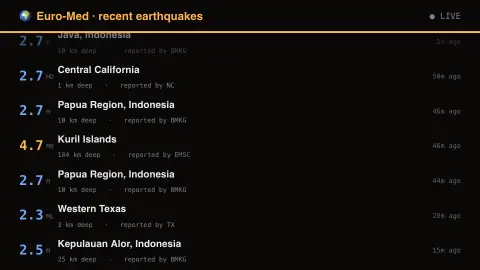
The Euro-Med Earthquakes screensaver shows recent earthquakes from the European-Mediterranean Seismological Centre, key-less. It's free, runs in your browser, and ESC exits.
Live preview
Press ESC to leave fullscreen. Settings are saved in your browser only.
How the Euro-Med Earthquakes screensaver works
The saver reads the source described above and draws it on a canvas — no account, no tracking.
Recent earthquakes from the European-Mediterranean Seismological Centre, key-less. Each event names the national agency that reported it, and the Mediterranean is covered far more densely here than in the site's USGS-fed quake savers.
It refreshes on a schedule, so what you see stays current.
Colours and any options can be changed in settings; nothing is stored beyond your own browser.
Where the Euro-Med seismic reports come from
The European-Mediterranean Seismological Centre is an international, non-governmental, not-for-profit organisation. It began operating in 1975 and has been headquartered since 1993 at Bruyères-le-Châtel in France, inside a laboratory of the French Atomic Energy Commission (CEA). Its aim is to determine earthquake epicentres in the Euro-Mediterranean region rapidly and share them with authorities and member institutes.
It receives seismological data from more than 65 national agencies, mostly in the Euro-Mediterranean region, and also passes data on to other centres such as the International Seismological Centre and the US National Earthquake Information Center. Alongside instrument data it gathers felt reports from eyewitnesses, including questionnaires, pictures and videos, to document how an earthquake was experienced.
Each event lists an origin time, a location with a descriptive region name, a depth and a magnitude. Early solutions are provisional and can be updated as more data arrive. Regional detail is strongest where contributing networks are dense, so a quake missing from the list does not mean the ground was still.
A worked example
Recent earthquakes from the European-Mediterranean Seismological Centre, key-less. Each event names the national agency that reported it, and the Mediterranean is covered far more densely here than in the site's USGS-fed quake savers.
Settings & tips
- Accent and Background recolour the display.
- Every number on screen comes from the live source — nothing is simulated.
- Press ESC to leave fullscreen.
Frequently asked questions
- Is this real data?
- Yes — it comes from the source named on this page and is refreshed on a schedule.
- Is a key needed?
- No. This source is fully key-less.
- Is it free?
- Yes — free, no download, in your browser.
- Why does a quake’s magnitude change after it first appears?
- Early values are provisional. As more stations and agencies contribute, the solution can be recalculated and published values updated.
- Is the centre limited to Europe?
- Its mission and strongest coverage are in the Euro-Mediterranean region, where most of its contributing agencies are. Coverage elsewhere should not be assumed to be as detailed.
- What are the region names in the list?
- They are descriptive labels for the area of the epicentre, so that offshore or remote events still have a readable location.