Peer Review Said Out Loud Screensaver
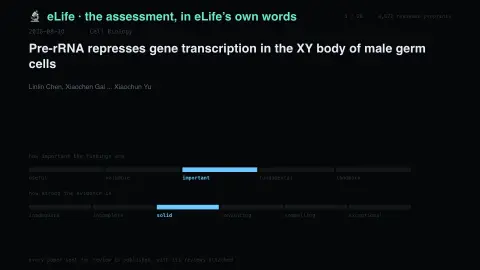
The Peer Review Said Out Loud screensaver shows eLife reviewed preprints and the fixed vocabulary its reviewers must use, read live and key-less. It's free, runs in your browser, and ESC exits.
Live preview
Press ESC to leave fullscreen. Settings are saved in your browser only.
How the Peer Review Said Out Loud screensaver works
The saver reads the source described above and draws it on a canvas — no account, no tracking.
eLife reviewed preprints and the fixed vocabulary its reviewers must use, read live and key-less. Everything sent for review gets published with an assessment attached: how important the findings are, and how strong the evidence is, in plain words.
It refreshes on a schedule, so what you see stays current.
Colours and any options can be changed in settings; nothing is stored beyond your own browser.
eLife's assessment vocabulary
eLife changed its publishing model, and since 2023 every Reviewed Preprint includes an eLife Assessment. It replaced the earlier accept-or-reject decision after review: the manuscript is published as a reviewed preprint together with the reviewers’ reports and an assessment written by the editor who oversaw the review and the peer reviewers, summarising their collective view. Authors can then revise their paper.
The assessment draws on a shared vocabulary with two scales. Significance of the findings runs from landmark (far-reaching implications likely to shape the field widely) through fundamental, important and valuable to useful (focused importance and scope). Strength of evidence runs from exceptional and compelling through convincing and solid to incomplete (supports the main claims only partially) and inadequate (does not support the primary claims). eLife uses the fixed words to keep assessments consistent between papers.
These words are judgements by the editor and reviewers at the time of assessment. A modest label does not mean the work is poor, and a high one does not guarantee that its conclusions will hold. The saver displays the text as eLife publishes it.
A worked example
eLife reviewed preprints and the fixed vocabulary its reviewers must use, read live and key-less. Everything sent for review gets published with an assessment attached: how important the findings are, and how strong the evidence is, in plain words.
Settings & tips
- Accent and Background recolour the display.
- Every value on screen comes from the live source — nothing is simulated.
- Press ESC to leave fullscreen.
Frequently asked questions
- Is this real data?
- Yes — it comes from the source named on this page and is refreshed on a schedule.
- Is a key needed?
- No. This source is fully key-less.
- Is it free?
- Yes, and it runs entirely in your browser.
- Does eLife still accept or reject papers after review?
- No. Under the reviewed preprint model, eLife replaced accept/reject decisions after peer review with a published assessment, so the assessment carries the evaluation.
- What do the eLife Assessment terms mean?
- Significance runs from landmark, fundamental, important and valuable to useful. Strength of evidence runs from exceptional, compelling, convincing and solid to incomplete and inadequate. For example, convincing means sound, validated methods that match current standards.