Trending Pools Screensaver
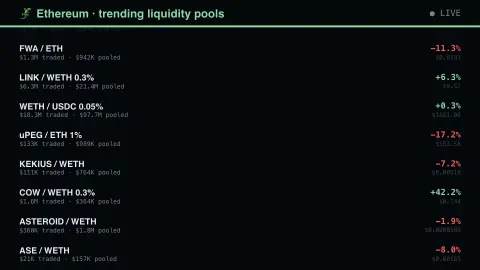
The Trending Pools screensaver shows the Ethereum liquidity pools with the most activity right now, each with its 24-hour volume, pooled liquidity and price move. It runs in the browser with nothing to install; press ESC to exit.
Live preview
Press ESC to leave fullscreen. Settings are saved in your browser only.
How the Trending Pools screensaver works
The saver reads GeckoTerminal's public API, key-free.
No account and no key: the request goes straight from your browser, or from this site's own refreshed copy of the feed where the source does not permit browser access.
Values are drawn on a canvas that resizes with the window, so it works on a laptop or a wall display.
If the source is unreachable the saver says so on screen rather than showing stale numbers as though they were current.
Trending pools on a decentralised exchange
GeckoTerminal is a decentralised-exchange (DEX) tracker for crypto prices and charts, and its on-chain DEX data is also offered through CoinGecko’s onchain endpoints. On many decentralised exchanges there is no traditional order book: trades happen against pools, smart contracts holding two tokens that anyone can fund. People who deposit tokens are called liquidity providers, and in the common automated-market-maker design the pool’s price is set by the ratio of the two assets inside it.
The columns on screen map onto that structure. Liquidity is the total value held in the pool, which tells you how much a trade can move the price. Volume over 24 hours is the value traded through it in that window. The price change compares the pool’s base token with its quote token. A pool with large volume but tiny liquidity can swing wildly on a single trade.
Pool creation on most DEXs is permissionless, so a trending list can include both established pairs and brand-new tokens with no history. Trending is an activity ranking, not a quality filter. Pools can be abandoned, and liquidity can be withdrawn abruptly. The page is a snapshot of what is busy, nothing more.
A worked example
Each row names a pool — a trading pair on a decentralised exchange — with the volume traded and liquidity pooled beneath, and the price and 24-hour change on the right. Unlike a centralised exchange, nobody approves these listings: anyone can create a pool for any pair, so the list includes tokens that did not exist yesterday.
Settings & tips
- Accent and Background recolour the display without changing the data.
- Add it to a Multi-view grid to watch it alongside other live savers.
- Press ESC at any time to leave fullscreen.
Frequently asked questions
- What is a liquidity pool?
- A smart contract holding a reserve of two tokens that traders swap against. Prices are set by the ratio in the pool rather than by an order book, which is what makes a decentralised exchange work without a matching engine.
- Is appearing here an endorsement?
- No, and this saver is explicit about that. Trending means volume, nothing more. A pool can trend because a token is being heavily promoted or manipulated just as easily as because it is genuinely interesting.
- Is this real data?
- Yes. It comes from GeckoTerminal's public API, key-free. Nothing is invented or simulated, and if the source cannot be reached the saver reports that instead of drawing something plausible.
- Does it cost anything or need an account?
- No. Every screensaver here is free, runs in the browser and needs no sign-up. This one uses a public API that requires no key.
- What does a large price move in a small pool mean?
- Usually that little money is needed to shift the price. Low liquidity makes the quoted price volatile and easy to distort, so large percentages here are often not meaningful.
- Why are the tokens sometimes unfamiliar?
- Pool creation is permissionless on most DEXs, so new and obscure tokens can appear as soon as they attract trading. Familiarity of a name says nothing about legitimacy either way.
- Which blockchain does this list cover?
- The page title and summary refer to Ethereum pools. Other chains have their own pools and are not part of this display.