Blocks As They Land Screensaver
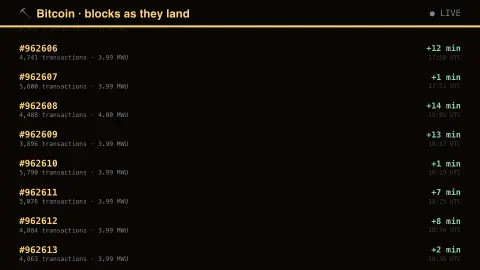
The Blocks As They Land screensaver shows the most recent Bitcoin blocks with their height, transaction count, weight and — most tellingly — the actual gap in minutes since the previous block. It runs in the browser with nothing to install; press ESC to exit.
Live preview
Press ESC to leave fullscreen. Settings are saved in your browser only.
How the Blocks As They Land screensaver works
The saver reads Blockstream's public Esplora API, key-free.
No account and no key: the request goes straight from your browser, or from this site's own refreshed copy of the feed where the source does not permit browser access.
Values are drawn on a canvas that resizes with the window, so it works on a laptop or a wall display.
If the source is unreachable the saver says so on screen rather than showing stale numbers as though they were current.
The anatomy of a Bitcoin block
Bitcoin groups transactions into blocks, and each block is chained to the one before it by a cryptographic hash. The height is the block’s position in that chain, counted from the first block. Miners compete to find a valid hash, and the network adjusts the difficulty every 2,016 blocks, which is about two weeks at the target spacing of ten minutes, to keep the average gap near that target.
Because finding a block is a random process, the gaps vary widely: many blocks arrive within a few minutes, and now and then a long wait occurs even though nothing is wrong. Two blocks in quick succession and a gap of half an hour are both ordinary. Timestamps in block headers are set by miners under loose rules: a block’s time must be later than the median of the previous 11 blocks, and nodes reject headers more than two hours ahead of their own clock. Measured gaps can therefore occasionally look odd, or even negative.
Block size is limited in weight units rather than a flat number of bytes. Under BIP 141, introduced with SegWit, weight is the block’s size without witness data multiplied by three, plus its total size, and a block may not exceed 4,000,000 weight units. The number of transactions in a block varies with their size, so it is a rough measure of activity, not of value moved.
A worked example
Each row is a block: its height, how many transactions it carried, its weight in megaweight units, and the gap since the block before it. That gap is the interesting column. Mining is a Poisson process, so although the average is ten minutes, gaps of two minutes and gaps of fifty are both normal and both happen most days. Gaps of twenty minutes or more are drawn in orange.
Settings & tips
- Accent and Background recolour the display without changing the data.
- Add it to a Multi-view grid to watch it alongside other live savers.
- Press ESC at any time to leave fullscreen.
Frequently asked questions
- Why are the gaps between blocks so uneven?
- Because mining is a memoryless random process. Each attempt has a fixed tiny probability of succeeding, so the waiting time is exponentially distributed. Ten minutes is the mean, not a schedule, and long gaps are expected rather than a sign of trouble.
- What is weight?
- A measure that replaced raw byte size when SegWit was introduced. The block limit is four million weight units, and witness data counts less than other data, so weight describes capacity more accurately than a byte count.
- Is this real data?
- Yes. It comes from Blockstream's public Esplora API, key-free. Nothing is invented or simulated, and if the source cannot be reached the saver reports that instead of drawing something plausible.
- Does it cost anything or need an account?
- No. Every screensaver here is free, runs in the browser and needs no sign-up. This one uses a public API that requires no key.
- What is block height?
- It is the number of blocks that precede a given block in the chain, so the genesis block has height zero and each new block adds one.
- How often does difficulty change?
- Every 2,016 blocks, which is about two weeks if blocks arrive every ten minutes. If the previous 2,016 blocks took longer than two weeks, difficulty falls; if they took less, it rises.
- Can a recent block be reversed?
- Occasionally the newest block is replaced when two miners find competing blocks at nearly the same time and the network settles on one of them. That is why payments are usually treated as safer after several further confirmations.