What Should I Pay? Screensaver
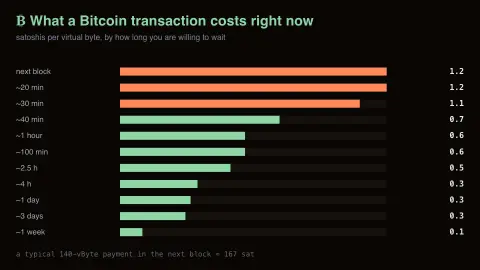
The What Should I Pay? screensaver shows Bitcoin fee estimates in satoshis per virtual byte for each confirmation target, from the next block out to about a week of waiting. It runs in the browser with nothing to install; press ESC to exit.
Live preview
Press ESC to leave fullscreen. Settings are saved in your browser only.
How the What Should I Pay? screensaver works
The saver reads Blockstream's public fee-estimates endpoint, key-free.
No account and no key: the request goes straight from your browser, or from this site's own refreshed copy of the feed where the source does not permit browser access.
Values are drawn on a canvas that resizes with the window, so it works on a laptop or a wall display.
If the source is unreachable the saver says so on screen rather than showing stale numbers as though they were current.
Inside a Bitcoin fee market
Bitcoin blocks have limited room, and miners choose which waiting transactions to include. Senders compete by attaching a fee, and because a transaction’s size varies with how many inputs and outputs it has, the fee is quoted per unit of size rather than as a flat amount. The unit is the virtual byte, introduced with Segregated Witness, which counts the witness portion of a transaction at a discount. Rates are expressed in satoshis, the smallest unit of bitcoin, per virtual byte.
Blockstream runs a block explorer built on its open-source Esplora software, whose fee-estimates endpoint returns an object mapping a confirmation target, counted in blocks, to an estimated fee rate in sat/vB. The documented targets run from 1 to 25 blocks, then 144, 504 and 1008, which is roughly one day, three and a half days and a week. An estimate is a forecast, not a promise.
A short target means paying more to be near the front of the queue; a long target means accepting a slow confirmation in exchange for a cheaper rate. When demand outruns block space the near-term end of the curve climbs fast. A sudden burst of activity can invalidate an estimate within minutes, and fees paid are never refunded if the market later calms.
A worked example
Each row is a target — next block, about an hour, a day, a week — with a bar for the estimated rate. The shape is the point. When the network is quiet the bars are almost equal, so paying for immediate confirmation costs barely more than waiting. When it is busy the left end towers over the right, and the footer converts the next-block rate into the actual cost of a typical 140-byte payment.
Settings & tips
- Accent and Background recolour the display without changing the data.
- Add it to a Multi-view grid to watch it alongside other live savers.
- Press ESC at any time to leave fullscreen.
Frequently asked questions
- What is a satoshi per virtual byte?
- The fee rate: how much you pay per unit of transaction size. Fees are charged by size rather than by amount sent, which is why moving a fortune can cost less than moving pocket change from many small inputs.
- Are these estimates reliable?
- They are inferences from the current mempool, not guarantees. If a burst of high-fee transactions arrives after you broadcast, your transaction can wait longer than the target suggested.
- Is this real data?
- Yes. It comes from Blockstream's public fee-estimates endpoint, key-free. Nothing is invented or simulated, and if the source cannot be reached the saver reports that instead of drawing something plausible.
- Does it cost anything or need an account?
- No. Every screensaver here is free, runs in the browser and needs no sign-up. This one uses a public API that requires no key.
- Why is the next-block rate so much higher than the slow rate?
- Only the highest-paying transactions fit in the very next block, so that slot is effectively auctioned. Waiting several blocks lets the queue clear, which is why the long-target end of the curve flattens.
- Does the fee depend on how much bitcoin I send?
- No. The fee depends on the transaction’s size in virtual bytes, not the amount moved, so sending a large sum can cost the same as a small one.
- Can a stuck transaction be sped up?
- Often yes, if the wallet supports replace-by-fee or child-pays-for-parent, both of which raise the effective fee after broadcast. Support varies from wallet to wallet.