Split-Flap Departures Board Screensaver
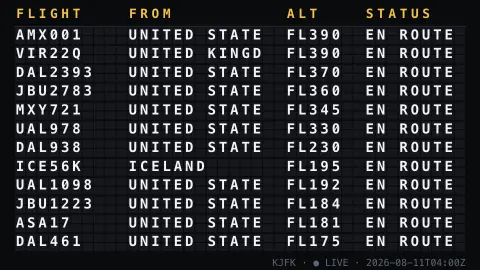
The Departures Board screensaver is a Solari-style split-flap board that clatters through live flights around an airport, each row flipping to show a callsign, country and status. It's fed by the same live OpenSky data as the Flight Radar saver. It's free, runs in your browser, and ESC exits.
Live preview
Press ESC to leave fullscreen. Settings are saved in your browser only.
How the Departures Board screensaver works
The board reads the same live aircraft data the Flight Radar uses — a snapshot of planes near your chosen airport, fetched from the OpenSky Network by the background pipeline.
Each row is a flight, and every character is a little split-flap tile. When the data changes and a tile needs a new letter, it flips forward through the alphabet one step at a time — the classic Solari mechanical cascade — until it reaches the right character.
Columns show the flight callsign, the aircraft's country, its flight level (or GND for aircraft on the ground), and a status of EN ROUTE or ON GROUND.
As the snapshot refreshes, rows reshuffle to the current flights and the whole board clatters over to the new arrivals and departures.
The split-flap display and its history
The split-flap display is a mechanical way of showing text. Each character position holds a stack of thin flaps with the top half of one character on the front of a flap and the bottom half of the next on the back. A motor turns a drum so that the flaps drop one at a time, changing the character with the familiar clatter. The Italian company Solari di Udine built many famous boards, and they became a fixture of airports and railway stations.
Because the flaps rotate in a fixed sequence, a letter cannot jump straight to another. The mechanism has to cycle through every character in between, which is why a change takes a moment and why the whole board seems to ripple when it updates. Many airports have since moved to LED and LCD screens.
The aircraft shown come from the OpenSky Network, a Swiss-based non-profit that provides open flight-tracking data, mainly for research. It began in 2012 as a research project and relies on receivers connected to the internet by volunteers and organisations, so coverage is uneven. The country column comes from the aircraft's transponder address and reflects registration, not the origin or destination, and a callsign is not always the same as the public flight number. This is a view of traffic overhead rather than an airport timetable.
A worked example
Set the airport to London Heathrow and the board fills with rows like BAW117 UNITED KINGDOM FL360 EN ROUTE, the tiles riffling as new flights replace old ones each refresh. Aircraft still taxiing show GND · ON GROUND. Turn up the flap speed for a faster, busier clatter.
Settings & tips
- Airport chooses which field's traffic fills the board — the same eight hubs as Flight Radar.
- Flap speed sets how quickly the tiles riffle to their new characters.
- Header color recolours the column titles for a different board style.
Frequently asked questions
- Are the flights real?
- Yes. The board uses the same live OpenSky aircraft data as the Flight Radar saver, refreshed on a schedule, so the flights shown are really near that airport.
- Why does it pair with the Flight Radar?
- Both read the same live aircraft file. The radar shows the planes on a scope; this board lists them with the satisfying clatter of a split-flap display.
- Does it show real departure times and gates?
- No — the free flight data doesn't include schedules or gates. It shows each aircraft's callsign, country, altitude and whether it's airborne or on the ground.
- Does it need an internet connection?
- It reads a live data file that the pipeline updates online. Offline it shows a short notice instead of the board.
- Is the departures board screensaver free?
- Yes, free and browser-based with no key or download. Run it fullscreen and press ESC to exit.
- Why does the flap cycle through other letters first?
- The flaps are on a drum that turns in one direction through a fixed order, so reaching a given character means passing all those before it in the sequence.
- What is a callsign?
- It is the identifier an aircraft broadcasts, often an airline code plus a number. It may differ from the flight number printed on a ticket.
- What does the country shown refer to?
- It is where the aircraft is registered, taken from its transponder address, and it does not tell you where the flight started or is headed.